High-performing teams don’t just happen. They’re shaped over time, through awkward beginnings, growing pains, difficult conversations, and (eventually) real momentum.
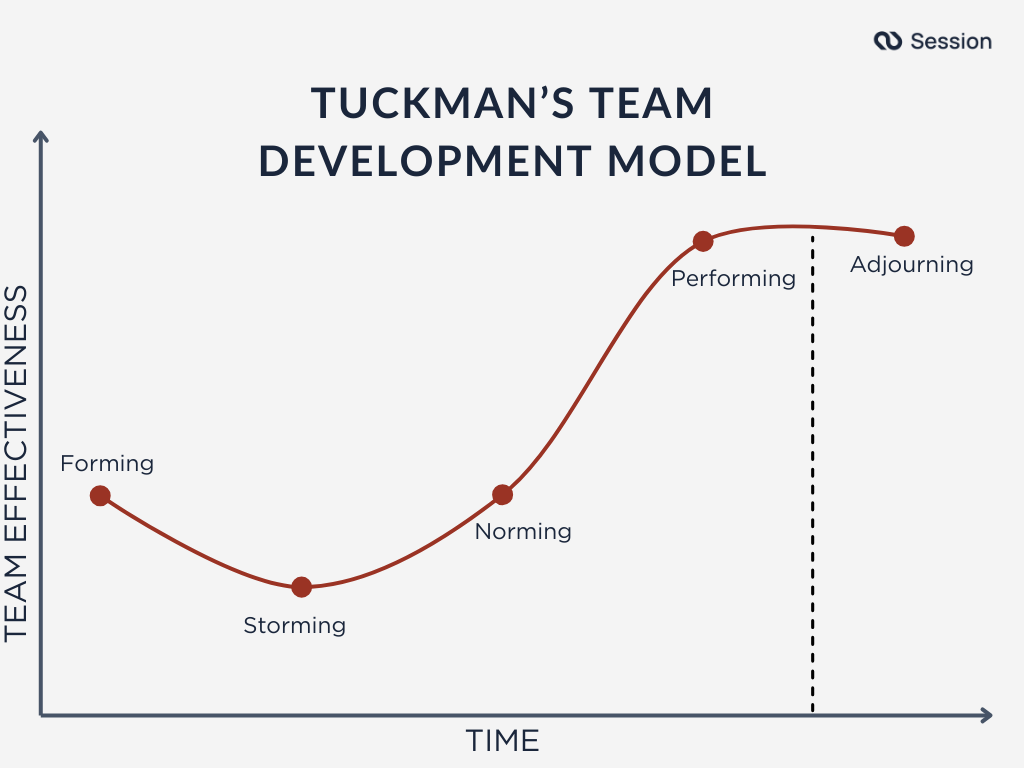
To get a better understanding of the development of teams, Bruce Tuckman’s Team Development Model comes in handy. The five stages (Forming, Storming, Norming, Performing, and Adjourning) offer HR leaders a practical way to understand what’s really going on beneath the surface of the team dynamics. More importantly, the model explains why a team that looks fine on paper might feel stuck or inconsistent in reality, and supports the ability to point towards the right interventions at the right time.
This guide is designed for HR professionals who want to better explain team dynamics. It breaks down each stage, the challenges teams typically face, and what kind of support is needed at the different stages - so teams can move through friction, and ultimately reach a state of sustainable flow.
The Origins: Who was Bruce Tuckman?
Back in 1965, American psychologist Bruce Tuckman set out to answer a simple question: why do teams so often feel messy before they start working well? After reviewing more than 50 studies on group dynamics, he noticed a clear pattern. No matter the industry or context, teams tend to move through the same stages as they form, clash, settle, and eventually hopefully perform. He called these stages Forming, Storming, Norming, and Performing. A few years later in 1977, together with Mary Ann Jensen, he added a final stage: Adjourning; this is what happens when a team wraps up and moves on.
It’s fair to ask whether a model created nearly 60 years ago still applies today. Teams simply move faster now. We work across time zones, tools, and increasingly with AI in the mix. But while the way we work has changed, the way people experience work hasn’t necessarily changed that much. We still bring the same emotions, insecurities, ambitions, and expectations into teams as we always have.
Tuckman’s model acts as a roadmap, supporting HR leaders and managers to understand that tension, disagreement, and uncertainty aren’t signs of failure; they’re often signs of progress. Especially during the Storming phase, the model offers reassurance: friction is not something to shut down, but something to work through.
We’ll take a closer look at what typically shows up at each stage, and how HR can support managers with the right interventions at the right time.
1. Forming: Building the Foundation
At this stage, teams are usually on their best behaviour. People are polite, a little cautious, and quietly trying to figure out where they fit. Questions are forming beneath the surface: What’s expected of me? Who makes decisions? How do I add value here? Most team members are looking to their manager for direction and reassurance.
What HR should focus on: Clarity. Early on, uncertainty is the biggest risk. The more clarity a team has, the faster they can move past hesitation and into real collaboration.
What helps in practice:
- Make sure every team member understands their role. Not just their responsibilities, but how their work connects to the wider team and business goals.
- Support managers in running a strong kick-off session that aligns the team on purpose, priorities, and ways of working.
- Encourage managers to be visible and decisive during this phase. Clear leadership now builds trust and reduces friction later.
2. Storming: When the Politeness Wears Off
In this phase, the initial niceness fades, expectations collide, and different working styles start to rub against each other. Disagreements surface and energy can dip. For many teams, this is the hardest phase, and the one where people are most likely to disengage or leave if it’s mishandled.
What HR should focus on: Psychological safety.
Storming isn’t a sign that something has gone wrong. It’s a sign that people care enough to speak up.
The risk here isn’t conflict itself, it’s unresolved conflict that goes underground and slowly bites away the trust.
What helps in practice:
- Help managers reframe conflict as a normal and necessary part of team growth, instead of a leadership failure.
- Introduce team agreements: shared expectations for how the team communicates, gives feedback, and handles disagreements when tensions rise.
- Step in early with mediation or coaching when interpersonal issues start slowing the team down. Small bottlenecks, if ignored, have a habit of becoming toxic.
Pro-Tip: Don't fear the Storm. Teams that never challenge each other are often playing it too safe. The goal isn't to avoid the friction, but to help the team move through it efficiently.
Worth noticing: Storming in virtual teams looks different. In remote or hybrid environments, conflict doesn’t always show up as heated debate. More often, it shows up as silence, fewer Slack replies, cameras staying off, passive-aggressive comments in shared documents, and so forth. When participation drops, chances are the team is storming; just quietly.
In these moments, HR can add real value by encouraging “process-only” conversations. These act as meetings that focus on how the team works together, not what they’re delivering. Naming the tension often diffuses it, and helps teams regain momentum.
3. Norming: Creating Cohesion
This is the phase where things begin to fall into place. Trust grows, people start appreciating each other’s strengths, and collaboration feels more natural. Roles are clearer, communication is easier, and the mindset shifts. You’ll notice the team needs less hand-holding. They start solving problems together, adjusting along the way, and gently holding each other accountable. This is a really positive turning point.
What HR should focus on: Empowerment. At this stage, too much oversight can actually slow the team down. HR’s role is to make sure the right structures, tools, and expectations are in place, then step back and let the team take ownership of how they work.
What helps in practice:
- Ease up on directive leadership and give the team space to own their processes and decisions.
- Introduce simple feedback loops or retrospectives so the team can reflect on what’s working and adjust without needing top-down intervention.
- Acknowledge and celebrate small wins. This reinforces trust and strengthens the feeling of “we’re in this together.”
A note on Hybrid Norming: In hybrid or remote teams, this stage doesn’t always look obvious. Cohesion can be harder to spot when people aren’t physically together. Be intentional about creating connection, small social rituals matter. Something as simple as five minutes of non-work conversation at the start of a meeting can help build the relationships that make this stage stick.
4. Performing: Sustaining High Impact
The team is working smoothly and confidently. They’re motivated, largely self-directed, and able to handle complex challenges without much oversight. Performance is strong and consistent.
What HR should focus on: Development and prevention. At this stage, the biggest risks are burnout and stagnation. The goal is to protect the team’s energy while keeping people challenged and engaged.
What helps in practice:
- Watch for signs of overwork and actively support balance; high performance should be sustainable.
- Use stretch assignments to keep top performers learning and motivated.
- Reinforce small, consistent habits that maintain culture, such as peer recognition or short coaching check-ins.
5. Adjourning: Closing the Loop
This stage happens when a project wraps up or a team changes shape. It’s often rushed or skipped, but it matters. How teams end impacts motivation, trust, and how people show up next time.
What HR should focus on: Recognition and transition. The goal is to create closure, capture value, and help people move forward feeling seen and supported.
When a project ends or a team is restructured, the "Adjourning" phase is often overlooked.
What helps in practice:
- Run a short post-mortem to capture learnings and retain institutional knowledge.
- Publicly acknowledge the team’s work and impact to reinforce pride and boost morale.
Ending well helps team-members start the next chapter stronger.
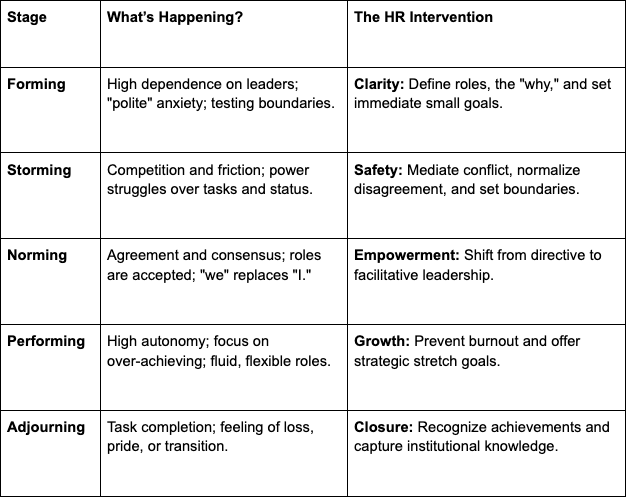
The Five Stages: A Directive Roadmap
Conclusion
The "Team Development Curve" isn't a linear path; a change in leadership or a new team member can often knock a "Performing" team back into "Storming." By using this model, HR can move from reactive troubleshooting to proactive team architecture - ensuring that every team has the support they need to reach the peak of the curve.