It’s that time of year again, the last stretch of 2025, and if you’re in HR, you probably feel it: the pressure to close the year strong, plan for what’s next, and keep people in the organization motivated in a market that isn’t exactly slowing down. It is a time that is both exciting and challenging with tight talent markets, employees seeking meaning and growth in their work, and technology fast evolving.
That’s why we’ve pulled together five strategic moves HR leaders can make before 2026. These are actionable, people-first steps you can take today; boosting retention through real career growth, building your team’s readiness for AI and new tech, and making your data actually work for you instead of drowning in dashboards.
1. Retention is more important than ever
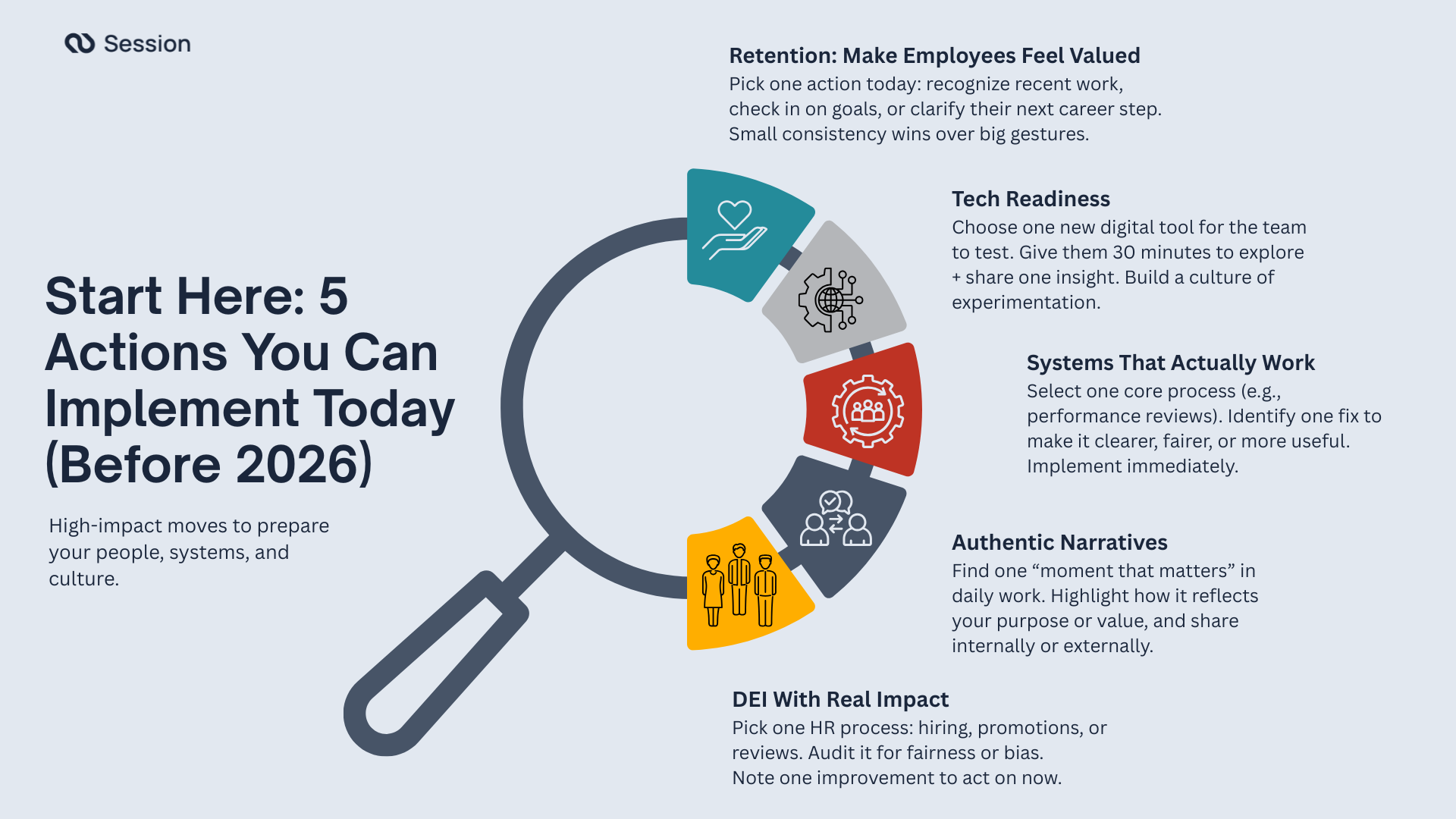
Start by identifying one core way to make employees feel valued, whether it’s recognizing their recent work, checking in on their goals, or clarifying their next career step.
As talent acquisition becomes expensive, competitive, and unpredictable, retention is quietly becoming one of the most powerful business advantages of 2026. Companies that will win next year aren’t only attracting great people, they’re creating environments where employees genuinely want to stay. Expectations have shifted: retention is now purpose-driven and built on delivering real value. Competitive salary still matters, but it’s no longer the differentiator.
Retention in 2026 is driven by:
- Clear career progression and skill growth: Many resignations are due to lack of advancement, not pay. Companies that make career paths visible and attainable keep their top talent.
- A culture people actually feel part of: McKinsey’s Organizational Health Index shows culture is a strong predictor of long-term performance. Winning companies connect people to shared purpose and values in a real, not corporate, way.
- Strong leadership and recognition: People often leave managers, not companies. When leaders check in, give credit, offer guidance, and make contributions feel valued, retention improves. People stay where they feel valued, it’s as simple as that.
2. Check readiness for tech advancements
Identify one digital tool your team can experiment with, and set aside 30 minutes for them to explore it and share a quick insight or tip, cultivating a culture of experimentation around new technology.
In the midst of the noise of all things AI, here’s the key: technology shouldn’t replace people. It should elevate them. The real win comes when HR uses tech to grow digital confidence, sharpen decision-making, and help teams work both smarter, and more creatively.
McKinsey’s latest research shows that organizations with strong capabilities in these areas outperform others by 2–6x in shareholder returns. The real story isn’t just ROI, it’s the why. Winning companies don’t throw tech at problems; they build the muscle beneath digital success: experimenting, learning fast, and operationalizing insights. They up-skill managers for smarter, data-driven decisions, give teams freedom to test new tools and ways of working, and treat digital capability as a core competency.
Gartner’s data additionally shows us just how quickly things are moving: in mid-2023, only a small minority of HR leaders were seriously exploring generative AI. By early 2025, nearly two-thirds are implementing or planning AI adoption. Digital maturity isn’t about buying tech, it’s about how confident, capable, and empowered people are using it. HR’s role is to build the structures and culture that turn new tools into better business outcomes.
3. Design organizational systems that actually work
Review one key process (like performance reviews) and identify a single change that would make it clearer, fairer, or more useful for employees.
The CHROs who stand out aren’t just great business partners, they understand how the whole system fits together. They notice how decisions flow and how day-to-day interactions shape the bigger business reality. They can zoom into details, then pull back to see the full picture that other leaders often miss. That perspective makes them true system designers, and it’s highly valued.
Performance management highlights this need: Gallup research shows only 2% of Fortune 500 CHROs believe their current approach inspires improvement, and just 1 in 5 employees feel reviews are transparent, fair, or helpful. This is a clear signal: systems that look fine on paper but don’t move the needle must change and HR can make a real difference here.
4.Focus on authentic narratives
Identify one “moment that matters” in your team’s day-to-day work and highlight how it reflects the company’s purpose or values.
Peter Ducker’s famous quote, “Culture eats strategy for breakfast” has never felt truer. Today, culture isn’t the soft side of business, it’s a performance driver. Culture isn’t the soft side of business, it drives performance. When employees clearly see the company’s story, values, and purpose, they feel a deeper sense of belonging, boosting engagement and retention.
HR should lead by working with executives and managers to co-create and reinforce the company narrative, not with posters, but by embedding meaning into day-to-day work, highlighting “moments that matter,” and translating purpose into behaviors. Companies that build a strong identity outperform: McKinsey shows top-quartile culture correlates with significantly higher shareholder returns. In today’s hybrid, fast-changing environment, aligning on meaningful ways to reinforce culture is a true competitive advantage.
5.Review DEI initiatives
Pick one key HR process; hiring, promotions, or performance reviews, and audit it for fairness or bias, noting one improvement to implement immediately.
In 2026, DEI’s value isn’t about messaging or awareness months, it’s about measurable progress and visible change. With AI embedded in hiring and performance systems, organizations must ensure fairness, transparency, and clear pathways for growth. Employees (especially the new wave entering the workforce), expect evidence, not promises, and are choosing employers accordingly.
The business case is clear: companies with diverse leadership are up to 36% more likely to outperform financially, and 76% of candidates consider diversity when applying. Forward-thinking organizations move beyond intentions to accountability, putting underrepresented talent at decision-making tables. DEI is now a performance strategy, and HR must drive it into reality.
Conclusion
Retention, digital readiness, systems that work, authentic culture, and DEI aren’t separate checkboxes, they all feed into each other, and they all drive real impact. HR builds workplaces where people want to stay, grow, and feel like what they do matters, we all know that. They think about how technology lifts people up instead of replacing them. And we care about building workplaces, where culture and purpose aren’t just words plastered onto a slide, but something employees experience every day. Last, but not least, we also know that diversity shouldn’t just be something we speak about, but be an integrated part of decision-making and leadership. The organizations that truly move forward are the ones where HR is a strategic voice at the table, driving outcomes from the very start, and we hope that this guide has given you enough inspiration to make at least 5 moves before 2026 “hit us”.