There’s a shift happening in how we define success. What used to open doors; degrees, job titles, years in a role, no longer guarantees a seat at the table. Skills are becoming the new language of opportunity, with the skills-based economy slowly reshaping the industry and hiring tendencies. Now, what is the skills-based economy? This implies the transition to an economy built on capability instead of purely credentials. This creates a space where hiring, learning and growth can each flourish as they are shaped by adaptability and potential. People are noticing that in this world, there is a steadier work-flow, people move further, and equal opportunities open up for everyone ready to learn and grow.
Additionally, the skills-based economy provides an ease to the dread of student debt, and steadily increasing unemployment rates following an expensive degree. Today, millions in the US are still paying off student loans, and the return just isn’t there. More than half of graduates end up underemployed within a year, and many stay stuck for a decade. This shift isn’t happening by chance, it’s being driven by how fast work itself is changing. AI, automation, and digital transformation are reforming what companies need and how people build their careers. Careers are changing quicker than classrooms can adapt, and that’s made skills the real currency of opportunity. The real question now is whether higher education can evolve fast enough to keep up, or if the future of learning will be built elsewhere.
Deconstructing Jobs into Skills
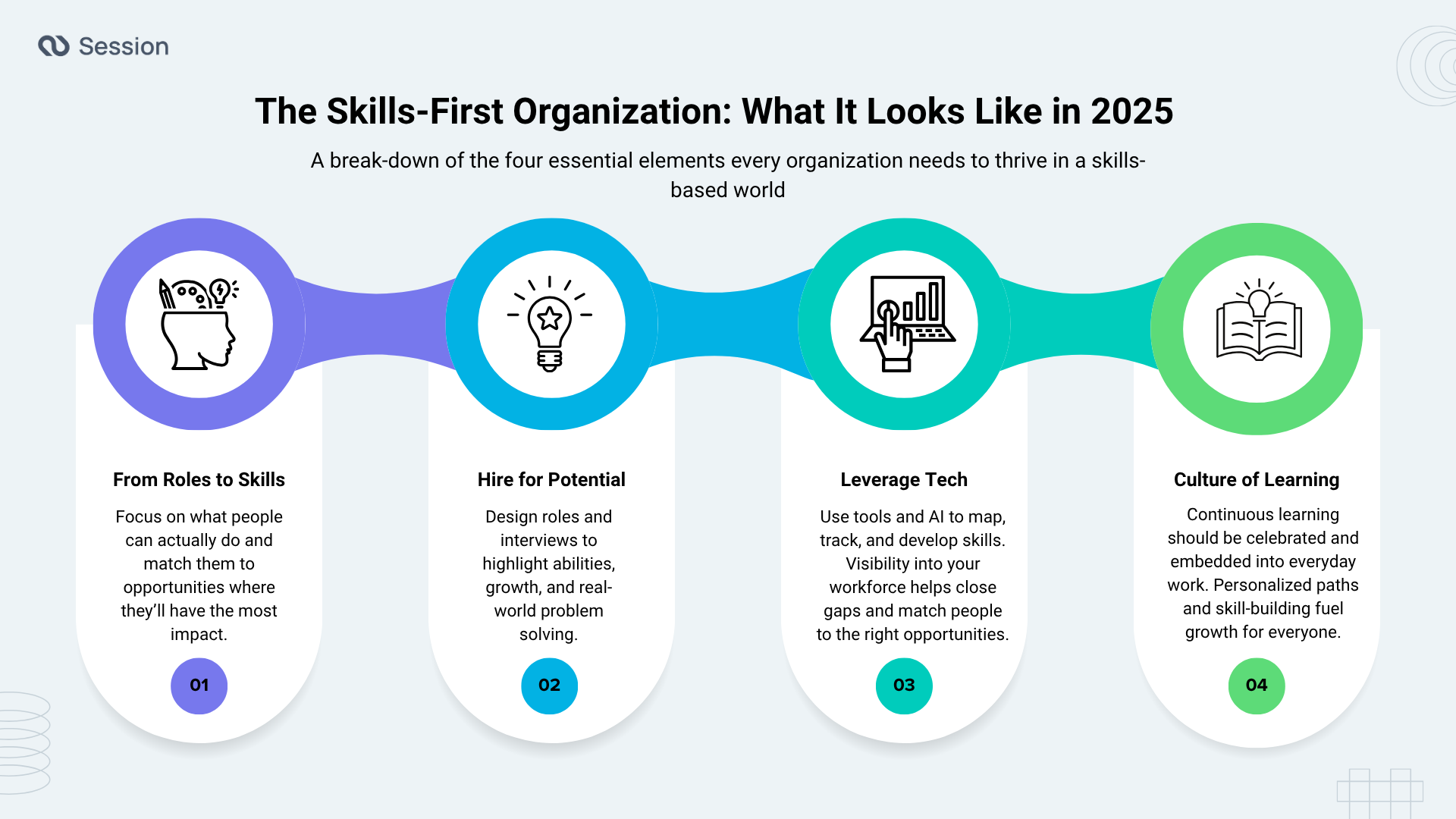
“Job deconstruction” is a new, emerging way of viewing work, matching people to opportunities based on their skills and potential impact, rather than locking them into fixed roles. It’s a move from “job descriptions” to “skill profiles.” In some cases, it means reimagining an entire company hierarchy. In others, the change is more subtle, with Unilever leading by example, where they have constructed a program in which employees can move fluidly between projects, contributing where their strengths matter most, without the traditional fixed roles.
To make this shift work in practice, companies first need clarity on what skills they already have, and what’s missing. That starts with a skills audit: mapping out the capabilities across your workforce to understand where your strengths lie and where new expertise is needed.
Once that foundation is clear, the last stage is about identifying the core skills required for each role (or project) and creating a system to match people to opportunities based on those capabilities. No matter the tool; a survey, a conversation, or an AI system - the real goal is simple: understand what people can do, not just what their role says they should.
Hiring for Skills, Not Pedigree
The real goal today in the recruitment process is to uncover who somebody truly is, diving into their mindset, experiences, and values, and not just what they’ve accomplished. Shifting to a skills-first approach starts with how you write the role itself. From the language you use to the qualities you highlight, job descriptions can either filter people out or invite the right ones in.
- Focus on impact, not titles. Describe what success in the role looks like, not just the tasks.
- List skills, not credentials. Highlight the abilities someone needs to thrive, whether that may be technical or soft, instead of degrees or years of experience.
- Invite personality. Encourage candidates to show who they are: how they think, solve problems, and collaborate, not just what they’ve done.
- Highlight growth and learning. Emphasise opportunities to develop new skills rather than requiring a perfect skill match.
Designing interviews and assessments around skills means giving people space to show what they can actually do, not just talk about it. That might look like real-world challenges or asking how they’d solve a problem your team faces. But even the best setup can be interrupted if bias creeps in. A true skills-based approach means questioning pre-existing assumptions about backgrounds, accents, or “fit,” and instead focusing on what matters most; ability, mindset, and the candidate's potential impact.
The Tech Stack for a Skills-Based Organisation
According to Deloitte, nearly 80% of companies say identifying and tracking employee skills is a top priority, yet only 23% have systems in place to do it effectively. The right stack can close that gap, helping teams see what skills they have, what they need next, and how to bridge the distance.
When choosing tools, focus on integration, usability, and scalability. The best platforms empower people, giving everyone visibility into how their skills connect to opportunities and growth. And how does one choose the right technology for your organisations' needs? Start by identifying your organization’s biggest gaps. Is it understanding existing skills, enabling development, or matching people to the right projects? From there, map tools to reach those goals. A smaller company might start with an intuitive learning platform to up-skill employees, while a larger one could benefit from an integrated skills intelligence system that syncs with HR and performance data.
Skills intelligence systems and other intelligence tools go beyond what regular tools can accomplish. These platforms provide ease to the work-flow, by using AI to spot patterns, predict future skill needs, and connect the dots between what your team can do today as well as what they’ll need tomorrow. Instead of digging through spreadsheets, these platforms make it easy to see where the gaps are.
Build a Culture of Continuous Learning
As Deloitte’s research shows, both leaders and employees are already leaning into this shift. In a global study of over 1,200 workers and executives, the vast majority expressed a clear preference for a skills-based model over traditional job-based structures, and many organisations are already experimenting with what that looks like in practice.
To foster a culture of continuous learning, it is important to create personalised learning paths based on skills data. These act as customized educational sequences that have the ability to analyse an individual's skills and create a tailored learning journey from here. AI is being increasingly used to build these learning paths, and provide feedback on the overall journey.
Above all, building a truly skills-based organisation starts with culture. Learning shouldn’t feel like an extra task, it should feel like a shared value. When people are encouraged to explore new challenges, experiment, and grow (and that effort is seen and celebrated), learning becomes part of everyday work.
Conclusion
We’re moving into a world where what you can do matters more than what your title says. Shifting to a skills-first mindset isn’t about rewriting every existing process overnight, it’s about building confidence in change, and creating space for people to grow in new directions.
When learning and experimentation become part of everyday culture, people move ahead. And that’s what makes a skills-based approach so powerful: it gives everyone, at every level, a clearer way to see their potential and a fairer chance to use it, with larger talent pools, improved diversity, and better retention overall. A skills-based world gives both organisations and individuals the freedom to grow in real time; the real question is, is your organisation ready to seize that opportunity?