
Through my many years leading research centres and companies and advising leaders globally, I have observed that People and Culture (P&C) often functions within a self-imposed paradox. On one side, P&C leaders are the ethical stewards of the organization, championing empathy and culture. On the other hand, they are required to justify investments and measure impact using the complex economic language of the boardroom. The suggestion that one must choose between human empathy and data-driven rigour feels overly simplistic; this perceived chasm is, in fact, a fundamental flaw in how we design our measurement systems.
When strategic goals falter—when an innovation pipeline dries up or a complex transformation program stalls—I often find P&C is left without the coherent data story needed to provide a nuanced diagnosis. The real challenge is not merely adopting data, but designing a framework sophisticated enough to capture the full spectrum of the employee experience and its resulting economic value.
To secure this strategic mandate, I propose systematically integrating three distinct, yet deeply interconnected, classes of Key Performance Indicators (KPIs): Objective, Behavioral, and Subjective. This integrated approach allows us to move beyond simple scorekeeping toward true organizational diagnosis and strategic navigation.
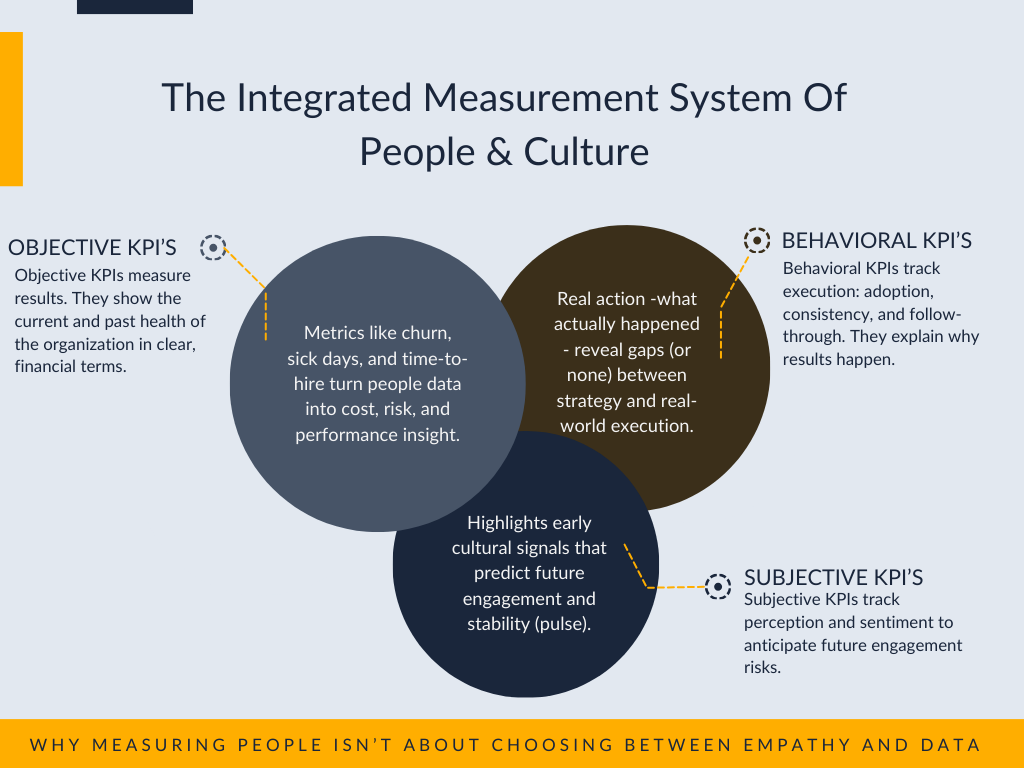
1. Objective KPIs: Quantifying the cost of friction
Objective KPIs are the fundamental, verifiable metrics of workforce stability and cost—the hard facts that translate directly into financial risk. These include measures we traditionally track, such as churn, sick days, attrition, and cost-per-hire.
In my experience, too many organizations collect these metrics haphazardly or treat them as mere administrative outputs. We should shift our mindset to treat them as leading indicators of economic friction.
Consider the simple act of a high-performer departing. This is not merely a staffing vacancy; it is a profound loss of intellectual and financial capital. Industry research consistently quantifies this friction, estimating that replacing a single employee can consume anywhere from 50% to 200% of that person's annual salary, depending on the role's specialization and the time spent on recruitment and ramp-up. When I help P&C leaders tie a persistent rise in regrettable voluntary turnover (an Objective KPI) to a quantifiable seven-figure risk, they transition from a cost centre to a vital risk management function.
Furthermore, objective data illuminates what I call the "invisible drag" on performance. An analysis by an absence‑management provider reports that companies with absenteeism rates above 4% experience around 67% higher turnover than those with rates below 2%, highlighting that physical absence is often a critical early warning signal of more profound disengagement and burnout. By systematically tracking these measures, P&C establishes a non-negotiable link between human well-being and the company's financial resilience.
Objective Measures as Financial Indicators:
- Employee Churn Rate (Voluntary and Involuntary)
- Absenteeism and Sick Days (tracked for frequency and duration)
- Time-to-Hire and Cost-per-Hire
2. Behavioral KPIs: The diagnostic map of execution fidelity
If Objective metrics define the operational status, Behavioral KPIs reveal the quality of the organizational effort. They track the specific actions and initiatives the company undertakes to achieve its people goals, effectively bridging the gap between strategy and ground-level execution.
The risk I see here is falling into what I call the "Activity Trap": the focus on launching initiatives ("We launched a new leadership program") rather than measuring their implementation fidelity ("What was the consistent usage rate?"). Budgeting millions for an initiative without tracking actual usage or adherence is a fundamental breakdown in organizational plumbing.
Behavioral KPIs provide the critical diagnostic layer. For example, suppose Objective data shows a plateau in internal mobility. In that case, I encourage P&C teams to consult Behavioral data on the Frequency of Manager-Initiated Mentorship Check-ins or the Usage Rates of the Internal Career Portal. If adoption is low, the diagnosis is swift: the execution (the behavior of managers and employees) failed, not necessarily the strategic intent. This clarity allows leaders to intervene with surgical precision, targeting cultural nudges and accountability measures rather than scrapping the entire program.
Behavioral Measures as Diagnostic Tools:
- Leadership Training Program Completion Rate (validated by assessment, not just attendance)
- Frequency of 1-on-1 Manager/Employee Check-ins
- Adoption Rate of New Tools and Cultural Mechanisms
3. Subjective KPIs: The cultural pulse and leading indicator
Subjective KPIs capture the collective mood, perception, and conviction of the workforce. They are the organization's primary heart rate monitor, and while often labeled "soft," they are, in my view, the most potent leading indicators of future Objective and Behavioral outcomes.
Subjective data answers the crucial, philosophical, and strategic question: “Do our people believe our efforts are right, valuable, and aligned with a clear vision?”
It is through regular pulse checks, employee engagement surveys, and thematic analysis of qualitative feedback (like exit interview data) that P&C gains its social currency. We know that the employee's belief system directly correlates with business results. Gallup research confirms that highly engaged employees—a measure derived primarily from Subjective KPIs—drive a 23% difference in profitability compared to those who are less engaged.
A low score on the Perception of Vision Clarity metric (Subjective) suggests future organizational drift and poor prioritization, which will inevitably show up months later as low training adoption (Behavioral) and higher voluntary attrition (Objective). By listening actively to the cultural pulse, P&C provides the early warning system that allows leadership to steer before the iceberg hits.
Subjective Measures as Predictive Signals:
- Employee Engagement and Satisfaction Scores (e.g., eNPS)
- Perception of Leadership/Vision Clarity
- Stated Effectiveness of Initiatives ("Did this policy improve your work-life balance?")
Conclusion: Integrated clarity as the new strategic mandate
The path forward for P&C is through integrated clarity. The actual strategic value is unlocked when the three pillars are viewed as a unified diagnostic system:
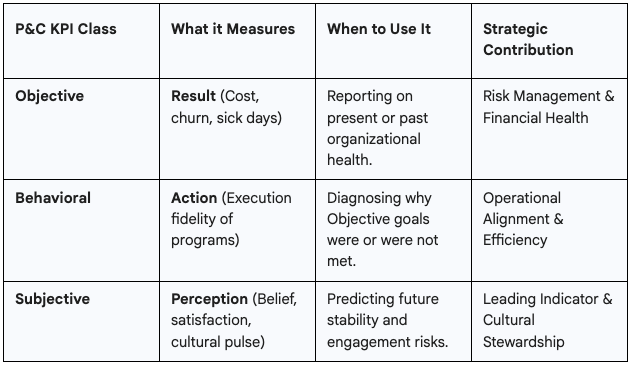
Imagine the difference: When a key executive asks why performance is flagging, I want P&C to move beyond isolated figures. Instead, I want them to tell a comprehensive, evidence-based story: “Our Objective data showed a 4% rise in regional turnover. Our Subjective data predicted this six months prior, with a decline in our ‘Manager Support’ score. This subjective failure correlated directly with low manager participation (Behavioral KPI) in the required leadership program. We know exactly where the intervention is required: targeted support for managers in that region.”
This integrated approach fundamentally redefines P&C. It shifts the conversation from the emotional to the evidential, empowering leaders to navigate complex processes—whether transformation, innovation, or cultural change—with a strategic authority grounded in human data. I believe the goal is to provide the organization with a more sophisticated mirror, ensuring that human capital is managed not just with empathy, but with the clarity of evidence.