When Session first published The New HR Playbook: Thriving in the Skills-Based Economy, the focus was clear: the traditional rules of work no longer apply. The macro economy has fundamentally shifted away from rigid job descriptions, linear resumes, and static university degrees. Progressive HR teams have successfully begun the hard work of deconstructing traditional roles into agile skill profiles, leveraging technology to map capabilities, and building open internal talent marketplaces.
But as this structural transition accelerates, a critical question emerges for People & Culture leaders:
If we successfully map every skill inside our organization, have we actually unlocked the full potential of our people?
The answer is no. If we look at a skills-based ecosystem purely through a technical data lens, we run into a major organizational blind spot. To truly thrive, companies must inject the human antidote to this data-driven trend. We need to look through the lens of Strengths-Based Leadership - a framework centered on moving away from treating people like resource inputs to be optimized and instead focusing entirely on unlocking human vitality.
To build an organization that is not just agile but truly sustainable, we must understand the critical distinction between a skill and a strength, and discover where the true magic happens.
The Crucial Distinction: Skills vs. Strengths
Many HR technologies and competency frameworks use the words "skills" and "strengths" interchangeably. This is a profound mistake. They are two entirely different psychological and operational dimensions:
- A Skill is the "What" (Acquired Capability): It is a learned proficiency, a tool, or a tactical behavior. It gives an individual the capability to solve a specific task. Skills must be continuously updated because they have a rapid half-life in a tech-driven market. Examples include: Data analytics, writing Python code, financial modeling, or managing a contract dispute.
- A Strength is the "How & Why" (Innate Energy): It is an individual's natural cognitive wiring, psychological talents, and core drivers of intrinsic motivation. Strengths are stable over time and dictate how a person feels energized while doing their work. Examples include: Deep empathy, strategic framing, contextual thinking, command, or relational orchestration.
The Energy Trap: Capability Does Not Equal Vitality
The central trap of a purely skills-based marketplace is simple:
Just because an employee has the skill to solve a task does not mean that task gives them energy.
Consider an internal talent marketplace running entirely on skills metrics. The system flags an individual who has a verified skill tag for auditing complex, messy data spreadsheets. Because the data loops perfectly, the platform continuously routes data-cleansing sprints to this employee's desk. They execute the task flawlessly because they have the capability.
However, spending forty hours a week inside spreadsheets completely drains their internal battery because their innate psychological strength lies in ideation, human connection, and public storytelling.
When you assign work based purely on what people can do, rather than how they are energized, you borrow immediate execution speed today at the cost of stress, burnout, quiet quitting, and resignation letters tomorrow.
The Magic Fusion: Building Skills Atop Strengths
True organizational magic doesn't happen when you simply upskill an employee in a vacuum. The magic happens when you build dynamic skills on top of immutable, innate strengths.
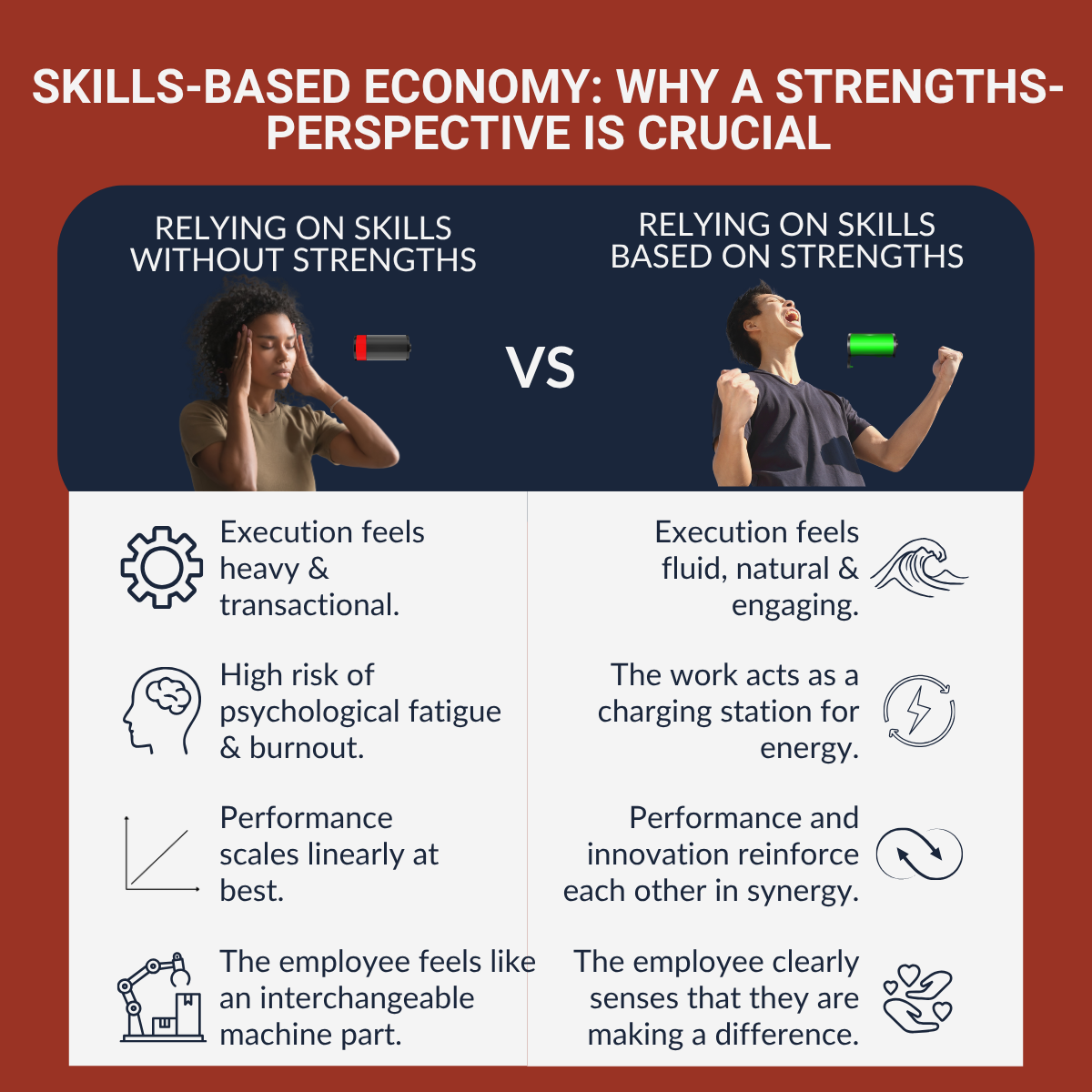
When a leader aligns a business task with a project member who has the required learned technical skill and the natural energetic strength to fuel it, productivity doesn't just increase - it transforms. A presentation delivered by someone who has the skill of public speaking combined with the innate strength of "Communication" or "Woo" (“Winning others over”) will always achieve a vastly superior strategic outcome than someone who simply checked the proficiency box.
Upgrading the Playbook: 4 Actionable Moves for HR Leaders
To future-proof your organization, you must integrate a strengths lens directly into your skills-based architecture. Here is how to upgrade your playbook today:
1. Move from "Headcount Planning" to "Skills & Capacity Planning"
Traditional HR budgeting focuses heavily on tracking "warm bodies in fixed seats". In a skills economy, this static approach no longer makes sense. Instead, leaders must map organizational needs against actual skills and capacity. To deliver on objectives, teams require specific capabilities (skills) that can be filled by a combination of full-time employees, part-time contributions, contractors, and on-demand gig workers. By shifting the focus from how many people you need to which specific skills and underlying strengths are required to solve the next business challenge, HR can better analyze their resource inventory against active initiatives - unlocking hidden productivity and eliminating costly, redundant hiring cycles.
2. Build Two-Dimensional Talent Profiles
When implementing or upgrading your Human Capital Management (HCM) or skills intelligence software, do not settle for a one-dimensional taxonomy of capability tags. Layer a psychometric or human strengths assessment directly alongside your skills data. A truly modern talent profile must tell a manager or project-lead two things at a glance: What tools can this person use, and what psychological contexts set them on fire?
But don’t get me wrong - first things first, I know. If you haven’t yet even implemented a great HCM system, this is where you start. Don’t let the lack of a system's ability to track the strengths alongside skills hinder you in getting going. While automated tracking remains the ultimate target, your managers possess immense power to bridge the gap right now. Even without formal data tags, leaders can actively tune in to their team members' energy levels, laying a human foundation for strengths-based work distribution long before the technology is officially deployed, as we will touch upon in the next section.
3. Evolve Managers into "Energy Orchestrators"
In a fluid, skills-first company, the traditional manager who merely supervises daily outputs or acts as a task-master is obsolete; automated platforms can route project logistics. The modern leader’s job description must evolve into a coach and an “orchestrator of energy”. Train your leaders to hold regular, brief alignment check-ins with their team members, moving away from rigid retrospective annual evaluations and toward forward-looking, appreciative conversations: "Are the modular sprints you worked on this week fueling your natural strengths or draining your battery?"
An organization without managers who know what energizes their team-members are like smartphones with incredible features but only 1% battery in the future world of work.
4. Create "Portable Strengths Passports"
When employees move laterally, fractionally, or cross-functionally across different teams inside a fluid enterprise, they lose the static psychological safety of a permanent department or a fixed title. In a decentralized economy, their strengths become their anchor. Give your workforce ownership of a "Strengths Passport" that travels with them from project to project. This allows new project leads to instantly understand how to motivate, collaborate with, and unlock that individual without a long, painful learning curve.
Conclusion: Building on Strengths is The Ultimate Competitive Advantage
As artificial intelligence continues to democratize baseline technical skills and automate routine administrative workflows, access to basic capability data will become commoditized.
In tomorrow's labor market, your company's definitive competitive advantage will not be your skills database alone. It will be the vitality, adaptability, and psychological energy of your people.
By all means, let us build the fluid, agile infrastructure of the skills-based economy. Let us unbox our roles and streamline our delivery platforms. But as we prepare for the future of work, let us ensure our systems are built for the human spirit. Do not just map what your people can do - unlock, celebrate, and orchestrate and build on who they are, when they are most fully alive and at flow.