In the modern workplace, change is the only constant. Yet, according to McKinsey, 70% of change initiatives fail. Why? Because most organizations manage change as a series of technical milestones - new software, a restructuring, a strategic pivot - while completely ignoring the transition.
As an HR leader or manager, your success depends on your ability to distinguish between the two. Change is the external event. Transition is the internal, psychological process people go through to come to terms with that new situation.
To lead a team through the "messy middle" of transformation, we must combine two powerful frameworks: The psychological wisdom of William Bridges, as described in his book Managing Transitions and the behavioral design of Chip and Dan Heath, as described in their book Switch - how to change things when change is hard.
But first things first - why all the fuss about knowing the difference between change and transition? Let's take a look at that.
The Human Cost of Misdiagnosis: Change vs. Transition
In HR and organizational development, we often use "change" and "transition" interchangeably, but mistaking one for the other leads to costly misunderstandings. To lead effectively, we must recognize that change is situational, while transition is psychological.
Change is the external event - observable, measurable, and driven by business imperatives. It’s the "what" that happens to the organization: A merger, a scale-up, a "strategic reorganization", or the introduction of new reporting lines. While change can be planned and executed through a spreadsheet, the real challenge for HR lies in the transition that follows.
The Internal Shift
Transition is the internal process of how people internalize that change, adapt their mindsets, and shift their behaviors. Unlike a project rollout, transition is messy, non-linear, and deeply personal. What HR often diagnoses as "resistance" or a "lack of agility" is, in reality, a human response to loss.
Before employees can embrace a new beginning, they must navigate the grief of letting go. They may be mourning:
- Predictability: Familiar ways of working and established routines.
- Connection: Trusted colleague relationships and social capital.
- Identity: Decision-making authority or professional status.
- Belonging: The very culture they originally joined.
Moving Beyond Resistance
When we misread these natural emotional responses as simple stubbornness, we deepen the organizational divide. Supporting transition requires more than just a communication plan; it requires deliberate interventions - such as coaching, mentoring, and radical role clarity - to bridge the gap between the old and the new.
Success isn't earned by the technical execution of the change alone. It is earned by shaping positive change through behavioral design and honoring the human experience behind the org chart.
The Transition Framework: A Manager’s Guide
For the transition to go (more) smoothly, you must navigate the organization through three distinct phases, which I will describe in the following sections.
Phase 1: The Ending – Mastering the Art of Letting Go
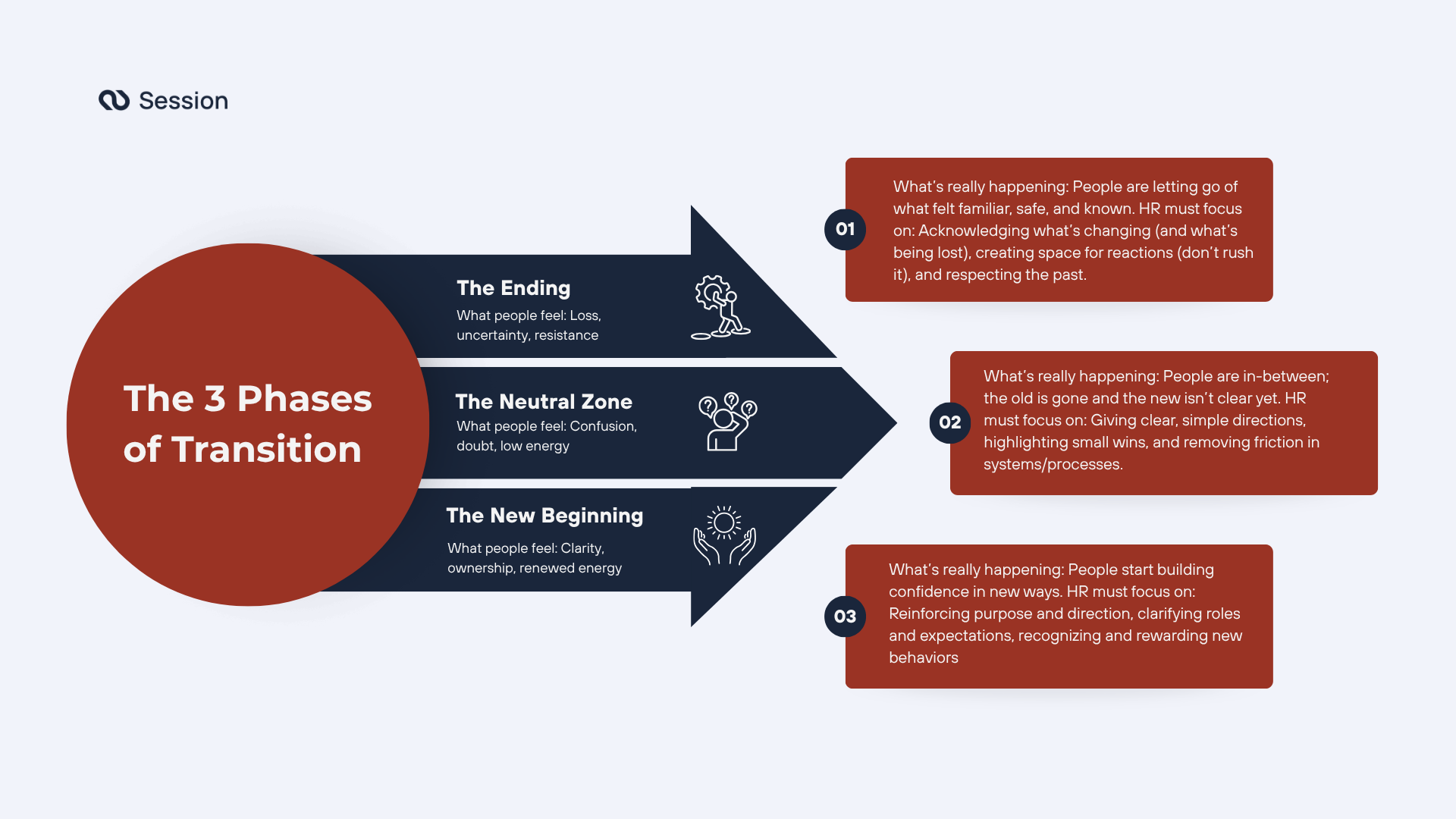
Every change begins with an ending. Before your team can embrace a "New Beginning," they must first process what they are losing. This is where most leaders fail; they try to rush people into the future before they’ve said goodbye to the past.
According to Bridges, people don't resist the change itself - they resist the loss. They may be losing their sense of competence, their social network, or their established routine.
How to Lead the Ending:
- Identify who is losing what: Don’t assume everyone feels the same. Some may lose status, while others lose a familiar process.
- Acknowledge the loss openly: As discussed in the article on Creating Psychological Safety, employees need to feel safe expressing anxiety or grief without fear of being labeled "un-agile."
- Respect the past: Don’t "trash" the old way of doing things. It likely served the company well for a time. Treat the past with dignity so employees don't feel their previous contributions were meaningless.
Phase 2: The Neutral Zone – Where Innovation Meets Anxiety
The "Neutral Zone" is the in-between time. The old way is gone, but the new way doesn't feel comfortable yet. Productivity often dips here, and confusion peaks. Research from the American Psychological Association (APA) highlights that prolonged uncertainty is one of the leading causes of workplace burnout, therefore we really need to take it seriously and be more mindful of how to navigate people through this part of the transition.
During this phase, common questions run through people’s minds:
- “What is expected of me now?”
- “Do I still have a place in this organization?”
- “Will I succeed under this new structure?”
- “Is this permanent, or will it change again soon?”
It’s no surprise that productivity can dip, confidence may be impacted, and trust in leadership is tested. Miscommunication or lack of support during this phase can accelerate disengagement, while informal networks and rumors often fill the information gap.
Yet, the neutral zone is not only a challenge, it can be viewed and approached as an opportunity. It is a necessary period for reflection and learning. When managed thoughtfully, it is the phase where innovative teams have the chance to redefine how they collaborate and deliver results.
In Switch, the Heath brothers describe this as a phase where the struggle between the Rider (the cognitive, logical part of people’s minds) and the Elephant (the unconscious, automatic part) becomes very visible. In the Neutral Zone, the Rider is exhausted by the lack of clarity, and the Elephant is spooked by the uncertainty.
Strategies for the "Messy Middle":
- Direct the Rider (provide clarity): What looks like resistance is often a lack of clarity. Script the "critical moves." Instead of saying "Be more innovative," give specific instructions like "Spend 15 minutes every Tuesday morning brainstorming one process improvement."
- Motivate the Elephant (engage emotion): What looks like laziness is often exhaustion. Change is draining. Find the "bright spots", identify where the new system is already working and celebrate those small wins.
- Shape the Path (change the environment): What looks like a people problem is often a situation problem. If you want people to use a new software, make it the default homepage. Remove the obstacles that make the old way easier than the new way.
Learn more about Shaping Organizational Change with Behavioral Design.
Phase 3: The New Beginning – Anchoring the Change
A "New Beginning" only happens when people develop the new identity and energy required to make the change work. This isn't a "roll-out date"; it’s a psychological milestone.
The 4 P’s of New Beginnings:
To anchor a transition, Bridges suggests leaders provide the four P’s:
- Purpose: Why are we doing this? (The rational "why").
- Picture: What will the outcome look like and feel like? (The emotional vision).
- Plan: How will we get there? (The step-by-step roadmap).
- Part: What is my specific role in the new reality?
On top of this, the following helps:
- Clarity: What does success look like now?
- Consistency: Do your actions match the new strategy?
- Involvement: Give people ownership of the outcomes.
- Reinforcement: Reward the behaviors that align with the future.
The Power of "Shrinking the Change"
The Heath brothers argue that to keep the "Elephant" moving, you must "shrink the change". A massive transformation feels overwhelming. By breaking it into small, achievable milestones, you build a sense of momentum. This aligns perfectly with Strengths-Based Leadership, where focusing on what people do well allows them to tackle new challenges with confidence.
The HR Imperative: Individualize and Contextualize
Transition is not linear. Some team members will reach the "new beginning" while others are still stuck in "the ending”.
This is where individual support becomes vital. Unlike broad training sessions, professional business coaching provides the personalized space needed to address individual losses and "spooked elephants".
Summary for HR & Managers:
- Change is situational - Transition is psychological. Or in other words: Change management focuses on outcomes; transition management focuses on people.
- Accept the dip: Expect a dip in productivity during the Neutral Zone. Don’t panic, manage it.
- Clarity is kindness: Give the Rider a map, the Elephant a reason to move, and clear the Path of obstacles.
When we lead with both the logic of change and the psychology of transition, we reach the destination and we ensure our people are still with us when we get there.