What if the most expensive thing in your organization isn't the headcount, the tech stack, or the office lease? What if it's the way you're spending Tuesday afternoon?
We've built entire systems around tracking money; budgets, forecasts, sign-off processes for every cent that moves. And yet most organisations have almost no framework for how they spend the one resource that can't be recovered: Time.
Time isn't infinite, but most workplaces are spending it like it is.
The conversation around the four-day week tends to get loud quickly, being politically charged and simplified to headlines. But underneath the debate is something more important and much more universal. People are questioning the value of how their working hours are spent. And increasingly, so are the organisations they work for, forcing leadership teams to ask a question they've never properly had to answer: What is our time actually worth?
The companies leading the way are not demanding more hours. They're the ones who've started treating time as the most strategic asset on the balance sheet, and building everything around that. This guide unpacks what that shift looks like, why it matters, and what it takes to lead an organisation that understands the true cost of how it spends its hours.
Why Time Became the Real Currency
Knowledge work doesn't scale with hours. A talented strategist, engineer, or HR leader doesn't produce twice the value by working twice as long. Their best work comes from focused attention, clear thinking, and the mental space to actually solve hard problems. None of those things are guaranteed by time spent at a desk, and all of them tend to be deconstructed by the conditions most modern workplaces have normalised.
The average knowledgeable worker now spends more than half their working week in meetings or responding to messages. Inboxes, Slack channels, status updates, check-ins; implying the infrastructure of "staying connected" has become the single biggest drain on the time that actually moves work forward. We've added more tools, more touchpoints, and more visibility into what everyone is doing, and in doing so, we've systematically dismantled the conditions that make truly great work possible.
The result is a quiet inflation of time. Organisations are busier than ever, but yet, not proportionally more productive. Hours are being spent (enormous quantities of them) without any real accounting for what they're producing.
The 4-Day Work Week as a Stress Test
The 4-day work week is often discussed as a cultural or lifestyle shift, but in effect, it functions as something more revealing: a stress test of how organisations actually use time.
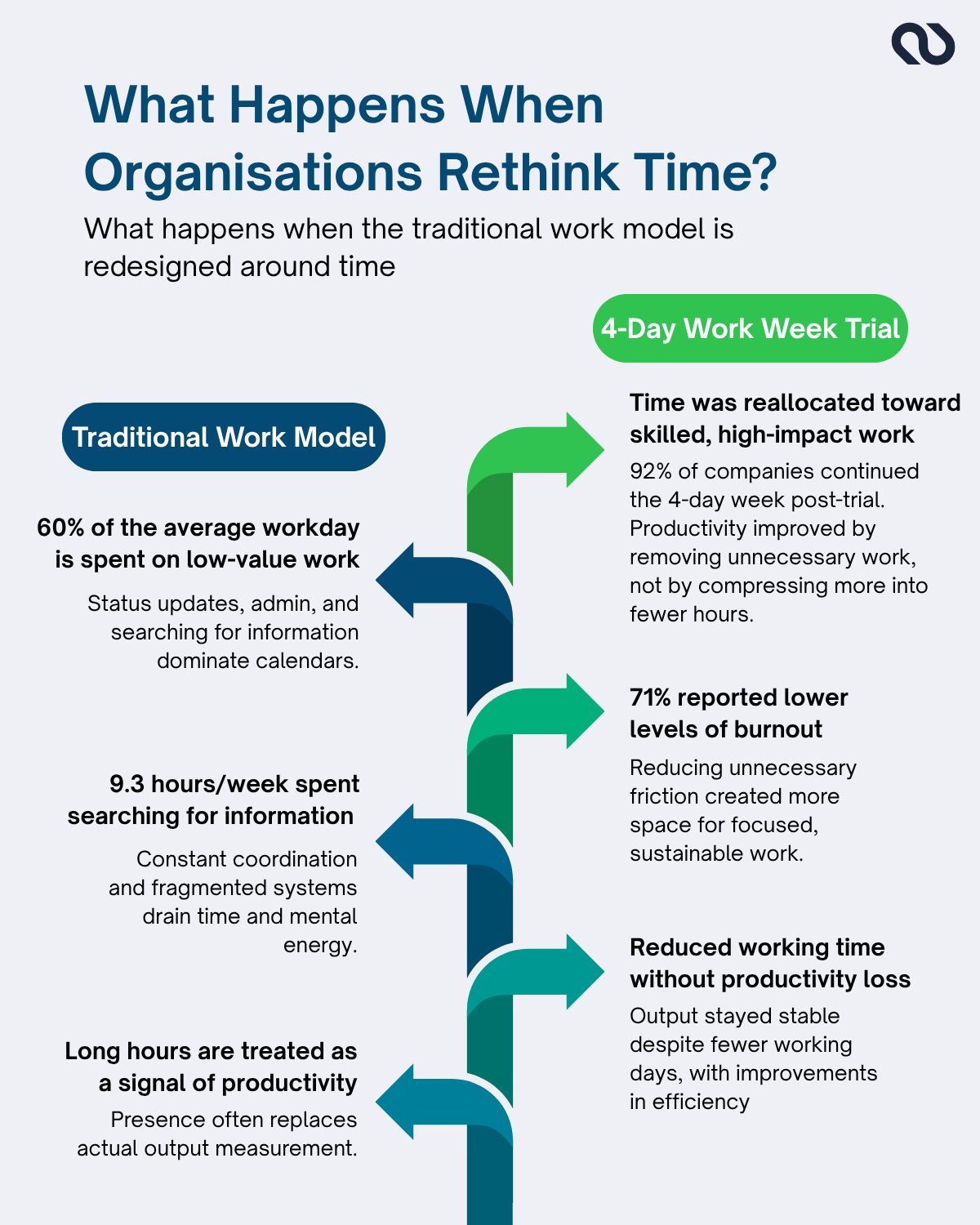
When put into practice, the results were striking. In the UK's landmark 2022 trial involving over 60 companies and nearly 3,000 workers, business revenue held broadly steady, sick days dropped by 65%, and 71% of employees reported lower levels of burnout. More telling still: 92% of participating companies said they would continue with the four-day week after the trial ended. These weren't just startups experimenting with culture. These were organisations that looked hard at their working hours and concluded that less time, structured better, was genuinely producing more.
But the question worth sitting with isn't why did productivity hold? It's what did they cut to make it work?
The answer, almost universally, was the same: unnecessary meetings, low-value admin, and the performative availability that fills most working days without contributing anything meaningful to actual output. The four-day week didn’t create productivity from scratch; it simply forced organisations to remove what was quietly eroding it.
This matters because the data had been pointing here for a while. According to Asana's Anatomy of Work Index, the average knowledge worker devotes 60% of their day to activities that aren't the skilled work they were hired to do; chasing status updates, sitting in avoidable meetings, hunting for documents, and so forth. A previous McKinsey Global Institute analysis found that employees spend an average of 9.3 hours per week simply searching for and gathering information. The work is there, however, the time for it (increasingly) isn't.
That said, the counter-argument deserves consideration. A 2023 systematic review found that alongside the positives, organisations also experienced scheduling problems, more intense performance monitoring, and a risk of benefits fading over time. For client-facing roles, industries with coverage requirements, or cultures where trust and async communication aren't yet established, compressing the week without addressing the underlying infrastructure creates new pressures.
The Trade-Off Triangle: Flexibility, Output, and Structure
The tension at the center of modern work sits between three competing forces: flexibility, output, and structure. Very few organisations can fully optimise for all three at the same time. Yet many continue trying to, which is precisely why so many workplaces end up feeling caught in a constant state of friction.
Flexibility without structure creates invisible accountability gaps. The autonomy may be real, but the systems needed to support it are not. Deadlines begin to slip, collaboration becomes inconsistent, and managers quietly fall back on the only metric that feels tangible: monitoring who is online and when. Over time, that erosion of trust turns flexibility into micromanagement and ultimately pushes people away.
An output-driven culture without flexibility becomes a burnout machine disguised as performance. Push hard enough on delivery, and people will deliver, until they eventually walk away. More often than not, it’s the highest performers who leave first, with their next opportunity already waiting for them.
Finally, structure without an output focus is often the hardest imbalance to detect because, on the surface, everything appears to function smoothly. There are processes, approvals, meetings, and regular check-ins. The organisation looks healthy, but strip away the activity and ask what any of it is actually producing, and the answer is often far less convincing.
What Organisations Actually Need to Rethink
Meetings
A one-hour meeting with eight people is rarely just one hour; it’s eight hours of collective time, plus the focus lost before and after. Across a week, that cost adds up quickly.
The most effective organisations treat meetings intentionally, not automatically. Instead of using them as a default check-in or visibility tool, they design them around a sense of clarity: the right people, the right purpose, and a clear outcome. Not every update needs a call, and not every discussion needs everyone in the room.
When meetings become more focused, people regain time for deeper work, collaboration becomes more meaningful, and trust naturally increases across teams.
Availability Culture
Constant availability comes at a cost. Every notification, “quick question,” and unnecessary urgent message interrupts focus and pulls people away from the work that actually requires depth and attention.
The strongest organisations recognise that presence and productivity are not the same thing. Instead of rewarding constant responsiveness, they create clearer communication norms and make space for uninterrupted work. Async-first ways of working are not simply about flexibility, they are about protecting concentration and allowing people to produce better outcomes. The end-goal is not to slow down communication, but to create more intentional communication.
Performance Measurement
If hours are what you measure, hours are what you’ll get, and these may not necessarily be results or impact, just time logged.
Moving from tracking inputs like time and tasks to outcomes like problems solved, value created, and real progress sounds straightforward, but in practice it’s not. It requires letting go of the comfort of visibility and shifting toward something more demanding: being really clear about what good work actually looks like. And that’s the real shift. It’s less about systems, and more about leadership.
Conclusion
Return on Investment has always meant money. It's time to apply the same rigour to time.
Across the practices outlined in this guide, a consistent pattern emerges: most organisations are not constrained by effort, but by how effectively time is structured and used.
The path forward is not a wholesale redesign of work, but a series of deliberate operational shifts: reducing default meeting load, setting clearer norms around availability, and moving from activity-based oversight to outcome-based clarity.
Individually, these changes are incremental. Together, they materially improve how time is allocated, shifting it away from coordination overhead and back toward work that drives meaningful impact. After all, If your company tracked time with the same discipline it tracks budget, what would the audit reveal?