Traditional Human Resources was built for an era of stability. For decades, organizations relied on static job descriptions, rigid hierarchy levels, and linear three-year career plans. We screened candidates based on historical resume titles and evaluated internal performance through backwards-looking reviews.
That legacy framework is breaking down. Today, fast-moving market requirements and severe talent shortages demand structural agility. Operating effectively requires HR to sit directly at the commercial table with a deep understanding of the underlying business model, capability needs, and strategic direction. To build a resilient enterprise, we must abandon rigid title matching and embrace two interconnected shifts: The skills-based economy and the rise of portfolio careers.
Decoding the skills-based economy: Beyond static titles
At its core, a skills-based organization separates human potential from static job titles. Instead of viewing an employee purely as a "Sales Operations Manager" or "Procurement Officer," we must map their underlying capabilities, adaptability, and core problem-solving strengths.
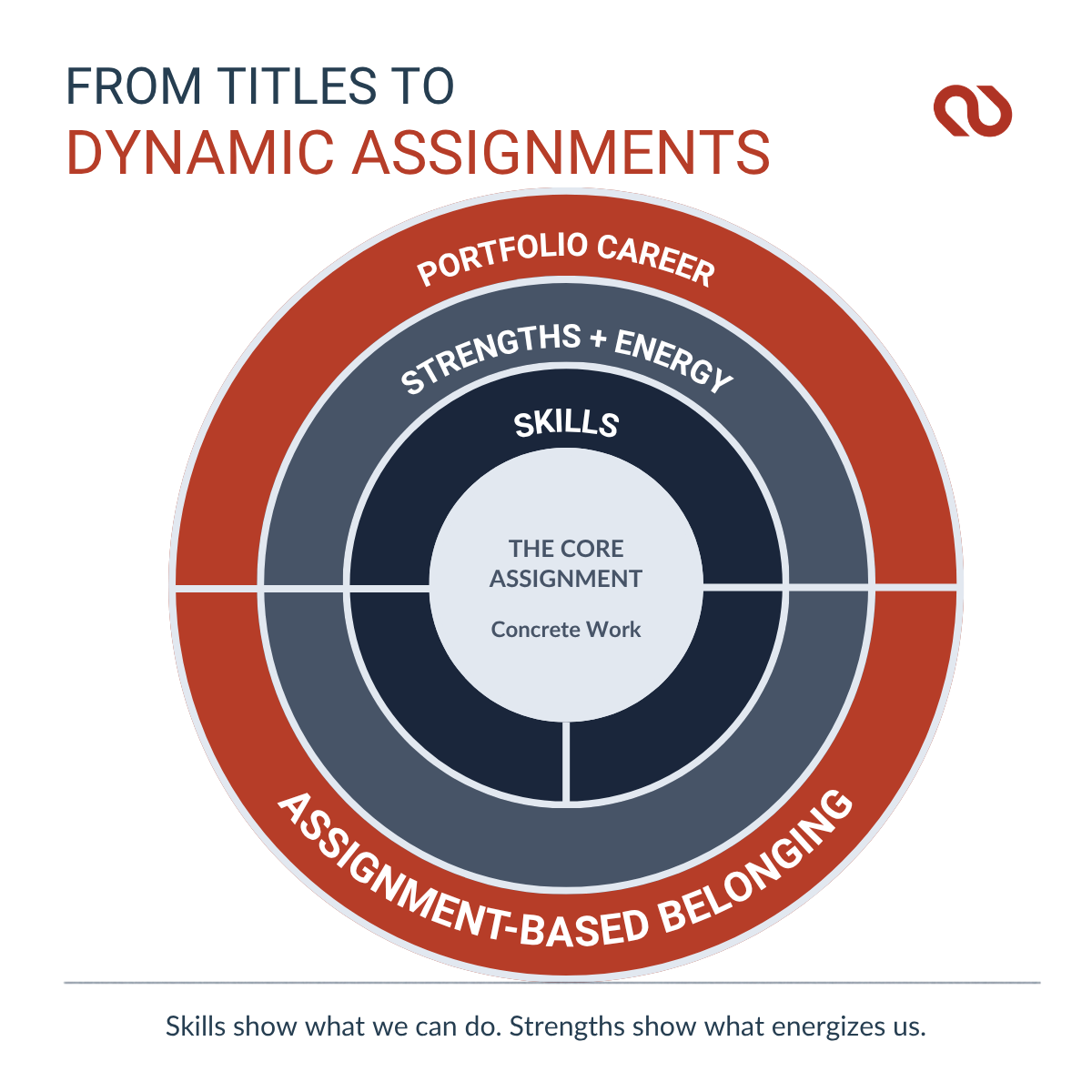
However, mapping static skills into a database is not enough. As Pernille Hippe Brun highlighted in her keynote on strengths-based leadership in a skills-based organization at a recent live session by Sympa, there is a fundamental difference between what an employee can do (a skill) and what energizes them to do it exceptionally well (a strength). If you map skills without accounting for intrinsic vitality, you risk creating energy traps - placing capable people into roles that exhaust them.
When we map both capability and energy, internal mobility unlocks naturally based on not only what the person in mind could do, but also what they would be really good at and energized by doing on a day to day basis.
In research and based on my own experience on unlocking latent talent it has been demonstrated again and again how traditional hiring mechanisms systematically overlook valuable skills by focusing on historical credentials. We saw this firsthand at Brødrene Dahl when evaluating an employee in Sales Operations. By looking past their immediate job title, we identified transferable problem-solving capabilities and high motivation for broader supply chain dynamics. We transitioned that employee into Procurement - a shift that delivered immediate business value while significantly boosting individual engagement.
The rise of portfolio careers and task-based belonging
As workforce expectations evolve, the traditional linear career ladder is being replaced by flexible, multi-faceted work structures. In his seminal 1994 work The Empty Raincoat, philosopher and organizational theorist Charles Handy popularized the concept of the "portfolio career" - predicting that work would increasingly consist of a portfolio of distinct skills, projects, and flexible commitments rather than a lifelong single-company tenure.
Herminia Ibarra’s research on career transition (Working Identity) further reinforces that modern professionals cultivate dynamic, multi-dimensional identities. Candidates and existing employees - across both younger demographics and senior staff - increasingly seek immediate skill application, project-based growth, and schedule flexibility over rigid five-year promotional paths.
Embracing portfolio careers requires HR leaders like me to challenge legacy management mindsets around presence and commitment. For instance, when sourcing specialized talent, traditional managers often insist on a standard five-day, full-time office presence. Yet, hiring a high-impact expert on a flexible two-day-a-week portfolio arrangement frequently yields far higher energy and productivity than settling for a full-time candidate who is a poor role fit.
In fact, I am myself a living example of someone who has hired exactly like that. I hired a person, who was a great fit, but who wanted to not only be connected with our company, but have the freedom to also exercise her skills and energy at other companies. We were so lucky she would like to work with us for two days a week - and we have accommodated so that this is possible. It is not easy, since it creates challenges when it comes to belonging for instance (more on that in the next paragraph), and for me to remind myself: “Is she here today or not”. But - it is challenges far outweighed by what we get! Her energy and commitment is worth it all and we learn a lot from her.
A common concern among leadership very understandably might be and as mentioned often is (at least it was for me, as mentioned) whether non-traditional or portfolio setups could weaken the corporate culture or sense of belonging for the employee and the other colleagues. But creating a sense of belonging and a feeling of community does not require sitting in the same physical office five days a week, in my experience. True organizational belonging is task-based. It is forged when cross-functional team members collaborate actively on clear, meaningful assignments, solve concrete business challenges, and deliver results together.
Modernizing talent acquisition: Sourcing capabilities and human-centric AI
Transitioning to a skills-based talent model requires redefining recruitment from the ground up. Just to be honest… Rather than re-posting generic, legacy job descriptions, recruitment must begin by defining what success looks like for the specific assignment at hand.
Once the core assignment is clear, talent acquisition teams can look for capabilities in non-traditional talent pools. Excellent sales capabilities, for example, do not only reside in candidates with "Sales Representative" on their CV; they can often be found in category managers, customer trainers, or operational project leads who possess strong persuasive agility and business acumen.
Artificial Intelligence tools like Copilot offer unprecedented speed in screening initial applicant data and identifying capability patterns. However, AI should act strictly as an assistant, never as the ultimate decision-maker. Algorithms evaluate past credentials, but human leaders must evaluate vitality, curiosity, and alignment. At least, that is my perspective and experience, so far - I am still learning, like I guess many others.
When interviewing candidates in an AI-driven environment - where applications may be partially machine-generated - leaders must then maintain active curiosity. We must prompt candidates to speak authentically about what brings them energy, what challenges spark their motivation, and how they apply their core strengths to real-world problems. In this new world of hiring, the questions we ask will determine if we get the right candidates or not, for sure.
HR as a commercial partner: Orchestrating vitality
For HR leaders, moving toward a skills- and strengths-based economy transforms our role within the organization. We must move from managing static personnel processes to serving as strategic capability architects. Line managers, similarly, must evolve from supervising static roles into "energy orchestrators", as Pernille Hippe Brun so elegantly put it in her keynote. Energy orchestrators who align dynamic talent to high-priority enterprise projects.
Transitioning an organization to this model requires firm commitment and perseverance. Legacy habits run deep, and managers will occasionally default to screening for familiar job titles. But by persistently challenging old paradigms - asking leaders what energizes their teams rather than simply tracking past KPIs - we can build an organizational ecosystem rooted in agility, resilience, and genuine human performance. Would you like to try - just like me?
Traditional Human Resources was built for an era of stability. For decades, organizations relied on static job descriptions, rigid hierarchy levels, and linear three-year career plans. We screened candidates based on historical resume titles and evaluated internal performance through backwards-looking reviews.
That legacy framework is breaking down. Today, fast-moving market requirements and severe talent shortages demand structural agility. Operating effectively requires HR to sit directly at the commercial table with a deep understanding of the underlying business model, capability needs, and strategic direction. To build a resilient enterprise, we must abandon rigid title matching and embrace two interconnected shifts: The skills-based economy and the rise of portfolio careers.
Decoding the skills-based economy: Beyond static titles
At its core, a skills-based organization separates human potential from static job titles. Instead of viewing an employee purely as a "Sales Operations Manager" or "Procurement Officer," we must map their underlying capabilities, adaptability, and core problem-solving strengths.
However, mapping static skills into a database is not enough. As Pernille Hippe Brun highlighted in her keynote on strengths-based leadership in a skills-based organization at a recent live session by Sympa, there is a fundamental difference between what an employee can do (a skill) and what energizes them to do it exceptionally well (a strength). If you map skills without accounting for intrinsic vitality, you risk creating energy traps - placing capable people into roles that exhaust them.
When we map both capability and energy, internal mobility unlocks naturally based on not only what the person in mind could do, but also what they would be really good at and energized by doing on a day to day basis.
In research and based on my own experience on unlocking latent talent it has been demonstrated again and again how traditional hiring mechanisms systematically overlook valuable skills by focusing on historical credentials. We saw this firsthand at Brødrene Dahl when evaluating an employee in Sales Operations. By looking past their immediate job title, we identified transferable problem-solving capabilities and high motivation for broader supply chain dynamics. We transitioned that employee into Procurement - a shift that delivered immediate business value while significantly boosting individual engagement.
The rise of portfolio careers and task-based belonging
As workforce expectations evolve, the traditional linear career ladder is being replaced by flexible, multi-faceted work structures. In his seminal 1994 work The Empty Raincoat, philosopher and organizational theorist Charles Handy popularized the concept of the "portfolio career" - predicting that work would increasingly consist of a portfolio of distinct skills, projects, and flexible commitments rather than a lifelong single-company tenure.
Herminia Ibarra’s research on career transition (Working Identity) further reinforces that modern professionals cultivate dynamic, multi-dimensional identities. Candidates and existing employees - across both younger demographics and senior staff - increasingly seek immediate skill application, project-based growth, and schedule flexibility over rigid five-year promotional paths.
Embracing portfolio careers requires HR leaders like me to challenge legacy management mindsets around presence and commitment. For instance, when sourcing specialized talent, traditional managers often insist on a standard five-day, full-time office presence. Yet, hiring a high-impact expert on a flexible two-day-a-week portfolio arrangement frequently yields far higher energy and productivity than settling for a full-time candidate who is a poor role fit.
In fact, I am myself a living example of someone who has hired exactly like that. I hired a person, who was a great fit, but who wanted to not only be connected with our company, but have the freedom to also exercise her skills and energy at other companies. We were so lucky she would like to work with us for two days a week - and we have accommodated so that this is possible. It is not easy, since it creates challenges when it comes to belonging for instance (more on that in the next paragraph), and for me to remind myself: “Is she here today or not”. But - it is challenges far outweighed by what we get! Her energy and commitment is worth it all and we learn a lot from her.
A common concern among leadership very understandably might be and as mentioned often is (at least it was for me, as mentioned) whether non-traditional or portfolio setups could weaken the corporate culture or sense of belonging for the employee and the other colleagues. But creating a sense of belonging and a feeling of community does not require sitting in the same physical office five days a week, in my experience. True organizational belonging is task-based. It is forged when cross-functional team members collaborate actively on clear, meaningful assignments, solve concrete business challenges, and deliver results together.
Modernizing talent acquisition: Sourcing capabilities and human-centric AI
Transitioning to a skills-based talent model requires redefining recruitment from the ground up. Just to be honest… Rather than re-posting generic, legacy job descriptions, recruitment must begin by defining what success looks like for the specific assignment at hand.
Once the core assignment is clear, talent acquisition teams can look for capabilities in non-traditional talent pools. Excellent sales capabilities, for example, do not only reside in candidates with "Sales Representative" on their CV; they can often be found in category managers, customer trainers, or operational project leads who possess strong persuasive agility and business acumen.
Artificial Intelligence tools like Copilot offer unprecedented speed in screening initial applicant data and identifying capability patterns. However, AI should act strictly as an assistant, never as the ultimate decision-maker. Algorithms evaluate past credentials, but human leaders must evaluate vitality, curiosity, and alignment. At least, that is my perspective and experience, so far - I am still learning, like I guess many others.
When interviewing candidates in an AI-driven environment - where applications may be partially machine-generated - leaders must then maintain active curiosity. We must prompt candidates to speak authentically about what brings them energy, what challenges spark their motivation, and how they apply their core strengths to real-world problems. In this new world of hiring, the questions we ask will determine if we get the right candidates or not, for sure.
HR as a commercial partner: Orchestrating vitality
For HR leaders, moving toward a skills- and strengths-based economy transforms our role within the organization. We must move from managing static personnel processes to serving as strategic capability architects. Line managers, similarly, must evolve from supervising static roles into "energy orchestrators", as Pernille Hippe Brun so elegantly put it in her keynote. Energy orchestrators who align dynamic talent to high-priority enterprise projects.
Transitioning an organization to this model requires firm commitment and perseverance. Legacy habits run deep, and managers will occasionally default to screening for familiar job titles. But by persistently challenging old paradigms - asking leaders what energizes their teams rather than simply tracking past KPIs - we can build an organizational ecosystem rooted in agility, resilience, and genuine human performance. Would you like to try - just like me?