
A generation ago, the question "what do you do?" had one answer. We named our job, and that was the whole story. That's no longer true for a lot of people, and it's not because they're indecisive or can't commit. It's because the old deal; to give a company our loyalty and receive stability in return, is slowly being replaced by a deeper wish for being able to design our jobs based on our own needs and a more resilient job-trajectory. As economic, technological, and organizational change continues to accelerate, many professionals respond by spreading their risk rather than concentrating it in a single employer.
There is a name for this, and it’s called career hedging, a career where the individual builds alternative income streams, skills, or professional networks so they aren't entirely dependent on a single job or employer. The full-time job is still there for most people, but it’s no longer the whole picture. Alongside it sits a personal brand on LinkedIn, a freelance client or two, an advisory role, and a network that exists independently of any one company.
It raises a simple question: If people are no longer loyal to the company in the way that they used to, how can we as HR best respond to that? Before we dig deeper into this, let’s take a closer look at what a portfolio career actually means.
What is a “Portfolio Career”?
A portfolio career might look a lot more ordinary and common than most people realize. It might be the senior marketing manager who has a full-time role, but also helps a startup on the side and has somehow ended up with a LinkedIn presence that opens doors she didn’t explicitly plan for. It might be the finance director mentoring early-stage founders in the evenings, not as a formal programme but because it started informally and stuck. It might be the HR lead who became a certified coach and now sees private clients on weekends, almost as an extension of work rather than a separate “side thing”.
And while these examples may sound subjective, the numbers suggest they're part of a much broader shift. Research suggests that more than 40% of professionals globally now report having more than one income stream, and that number is still rising. Fractional leadership - where senior executives offer their expertise to multiple organizations on a part-time or project basis, rather than committing to a single full-time role - is one of the clearest signals of this trend, reportedly doubling from 60,000 to 120,000 between 2022 and 2024.
What these people share isn't a specific setup or a particular industry. It's a mindset: the recognition that a career is something you own, not something that's handed to you and taken away once the business changes.
This Isn't Just a Young Person's Game
The portfolio career often gets dismissed as a Gen Z or millennial phenomenon; a byproduct of side hustles, creator culture, and declining loyalty to traditional employers. But that interpretation misses what's actually happening.
Whilst it’s true that Gen Z are currently paving the way, some of the strongest adopters aren't early-career professionals at all. They're senior leaders, specialists, and executives who have already spent decades building expertise, networks, and credibility. Once that foundation exists, work naturally starts to expand beyond the boundaries of a single role.
In many ways, the portfolio career becomes more common as careers mature. The more experience someone accumulates, the more opportunities emerge to apply it across different contexts. What changes here isn't ambition; it's where ambition can be expressed, and for many experienced professionals, the question is no longer "How do I move up?" but "Where else can my experience create value?"
What Career Hedging Means for Companies and HR
From an organizational perspective, the first instinct for many might be to see this trend as a threat. If your best people are building something on the side, are they still fully invested? Are they one great client away from walking out the door? It's an understandable concern, but it's also the wrong frame.
Workers with portfolio careers (some also call this moonlighting!) develop entrepreneurial thinking, faster decision-making, broader external networks, and increased digital fluency. In other words, the skills they're building outside your organization are often the same ones you need more of inside it. In a sense, employee side projects are professional development that don't cost the organization a penny. So, instead of fearing “moonlighting” - embrace and support it. It pays off, as Ron Friedman describes and explains in his newly released book “Superteams: The Science and Secrets of High-Performing Teams”.
What's changed today isn't employee commitment, it's the conditions that sustain it. Portfolio professionals bring genuine drive to their primary role, but that drive is contingent on receiving something in return: Real development opportunities, meaningful autonomy, and work that connects to something larger than a job description. When those conditions aren't met, disengagement happens gradually, as energy and ambition naturally get redirected outward. 43% of employees say there is nowhere left to grow where they work. For organizations, that number isn't a future problem to plan for, it’s a present reality to take direct action upon.
Three Actionable Ways for HR to Start Responding to Portfolio Careers
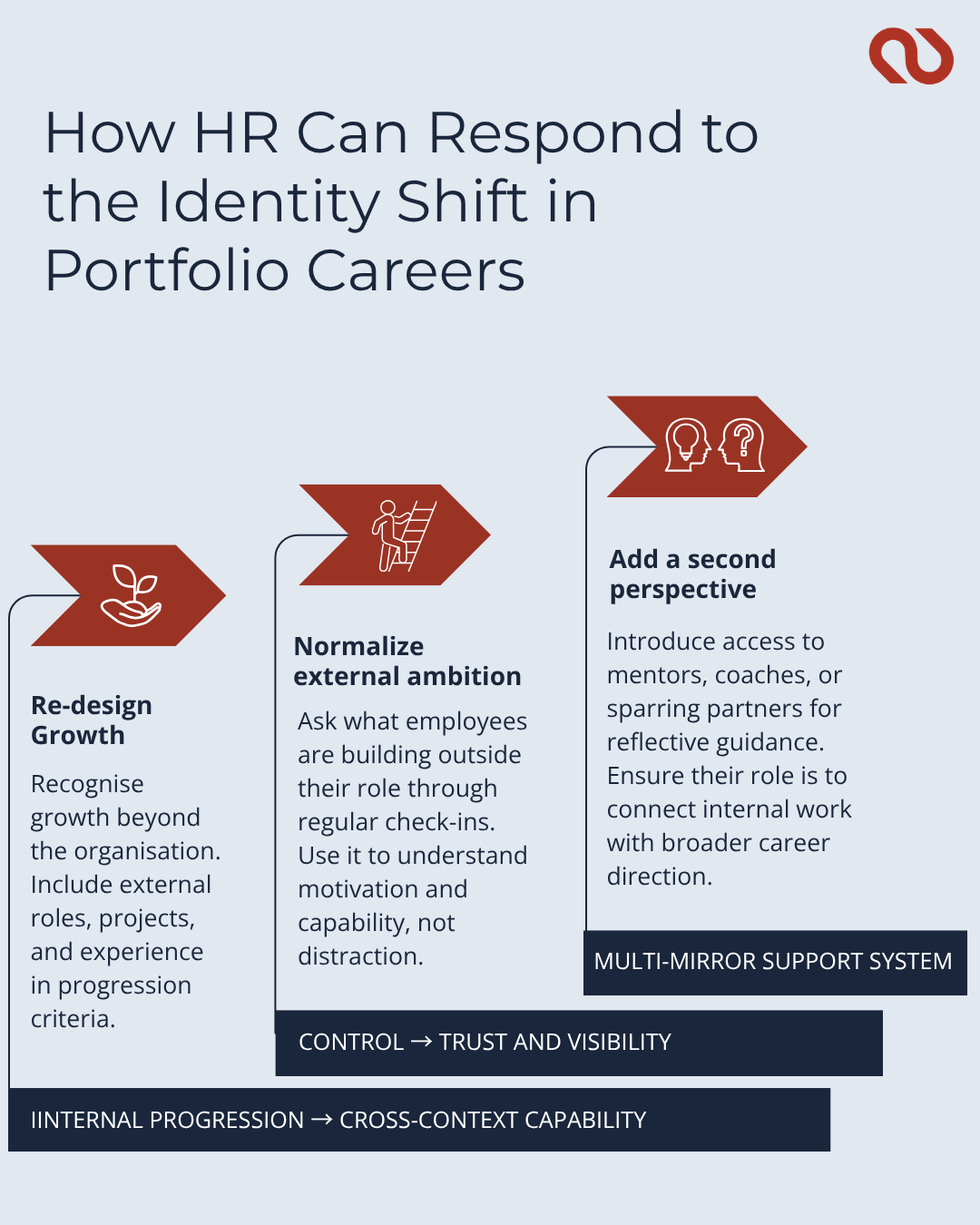
1. Redesign how you talk about growth
Most career frameworks are still built on a simple assumption: Progress is linear, visible, and internal. Titles go up, responsibility expands, and development is something that happens inside your organization. But growth in a portfolio career rarely looks like that, it's directly linked to the skills-based economy. A concrete place to start: Audit your current framework and ask whether external experience and skills built outside the organisation count as development. If the honest answer is no, that's worth changing, and making explicit, not just as something a good manager quietly acknowledges in a 1-1.
2. Make space for ambition that extends beyond the role
The instinct is to treat outside projects, advisories, or commitments as a threat to focus. In most cases, the opposite is true. Professionals who are growing outside the organisation tend to bring more back into it. The more productive question isn't how to limit that, instead it's how to support your employees in feeling safe to bring their drive for ambition out into the open. In practice, this can be as simple as adding one question to your existing check-in structure: "What are you building outside this role, and how can we support it?" That single shift signals that outside ambition is welcome, and gives HR real visibility into what your people are actually working on.
3. Offer people the perspective of someone who sees the full picture
In a traditional career, your manager knew where you'd been, where you were heading, and could tell when something was off. That relationship provided direction almost without anyone noticing. In a fragmented career, that person often doesn't exist anymore. This is where HR can step in with something ultimately very simple: Create access to a second layer of perspective. A coach, mentor, or senior sparring partner whose job isn’t performance management, but “sense-making.” This becomes someone who can help connect the dots between what a person is doing inside your organisation and what they’re building outside of it, and help them understand whether those pieces are pulling in the same direction or competing.
Without that external mirror, even high performers can end up optimising for the wrong kind of progress. With it, they don’t just perform better, they make clearer, more intentional choices about where their energy actually goes.
Conclusion
The old contract of loyalty for stability is broken. It’s time for HR to write a better one!
As work fractures across different roles, organizations, and side-gigs, a professional's true center of gravity is shifting away from static job titles toward the skills and projects that connect it all. When traditional corporate structure disappears, direction must be built deliberately.
By shifting HR's role from policing boundaries to facilitating "sense-making," companies can transform career hedging from a retention risk into a competitive advantage. When you give high performers the space to grow outside your walls, they will naturally bring their best, most innovative selves back inside them.
We wish you the best of luck in this new reality of how people view and manage their careers!