

It’s a Tuesday in March. A team member asks for a quick word, closes the door and raises a question that many may soon find themselves facing:
“I’ve heard that a colleague earns more than me for the same job. Why is that?”
If you’d need a moment to think, you’re not alone. For a long time, salary decisions have happened largely behind closed doors. Pay has been treated as a private matter, with little expectation that the reasoning behind individual salaries would ever need to be discussed openly. That is about to change. Pay transparency brings greater visibility, and with it, a greater responsibility for organisations to stand behind their pay decisions.
Across the EU, new pay transparency rules are on their way, as each country brings the EU Pay Transparency Directive into national law. A handful of countries already have their rules in place, while most, including Denmark, are still finalising theirs. In Denmark, the new rules are expected to take effect from 1 March 2027. Wherever you are, the upcoming pay review is an important opportunity to prepare, as the decisions made now will set the foundation for what comes next.
The new rules in brief
The rules are based on an EU directive and will affect both how organisations recruit and how they make and communicate decisions about pay.
In recruitment, candidates must be told the starting salary or salary range before pay is negotiated, and employers will no longer be allowed to ask about their salary history. Once employed, people will be able to request information about how their pay compares with the average for colleagues doing the same or equivalent work. Organisations must also make the criteria behind pay and career progression accessible to their employees.
The rules described here are based on the Danish bill, which has not yet been formally adopted, so some details may still change. Other EU countries follow the same directive, but each one decides how to implement it, and progress varies. Countries such as Italy, Slovakia, Lithuania, Malta and Greece have already adopted their rules, while others, including Germany and Austria, are still at an earlier stage. Details and timelines may therefore differ depending on where you are, so check what applies in your country.
This connects to a wider shift in how we think about work. As Pernille Hippe Brun, Session’s founder and CEO, highlighted in her keynote at Sympa’s event in Copenhagen this June, organizations are moving away from rigid job descriptions towards a focus on what people can actually do. Clear, skills-based criteria make pay easier to explain, and fairer to compare.
Preparing ahead of the new year
The weeks leading up to the new year are a strong time to get ahead. Pay decisions for 2027 are taking shape now, and the work you do today will make the conversations ahead feel far more manageable, for you and for your employees.
If you work in HR
Preparation starts with a closer look at your existing pay structures. Gender pay gaps are an important part of the picture, but differences often arise from the way people were hired and how their salaries were negotiated. Someone recruited during a competitive labour market, for example, may have secured a higher starting salary than other colleagues in comparable roles. Spotting these differences early gives you the chance to assess whether they’re justified, address any inconsistencies, and build a clearer rationale for any differences.
It also helps to agree now on how pay information requests will be handled: who receives them, how quickly you respond, and what you share. A clear process means every employee is met with the same fair answer, and no one is left to improvise. Just as importantly, bring HR and managers into the conversation before the pay round rather than after. They will often be the first person an employee turns to, and they deserve to feel prepared.
If you lead a team
As a people leader, you don’t need to be a pay expert, but you do need to understand the criteria behind your team’s salaries well enough to explain them with confidence. If there’s a salary you find hard to account for, raise it with HR now, while there’s still time to look into it, rather than waiting until someone asks. And in this year’s pay round, it’s worth pausing before agreeing to any one-time arrangement. A good rule of thumb is to ask yourself whether you’d feel comfortable explaining the decision to the rest of your team. If the answer is no, it’s probably worth a second thought.
When someone asks about pay
What’s really behind the question?
When an employee asks about their pay, the number is often only part of the story. Underneath, there’s usually a question about whether they feel valued and fairly treated. Someone who asks “why do I earn less?” may really be asking “does my work matter here?”
This is where you can make a real difference as a leader. Helping people understand and name their own strengths gives them a way to talk about their contribution, and not only their salary. As Pernille Hippe Brun, sharing further perspective, put it on Sympa’s HR Coffee Break podcast:
“Being very articulate about what it is I do well also transfers into pay transparency, because then you have a language for why you’re valuable.”
When people have that language, a conversation about pay can become a conversation about value. Keeping that in mind can change the tone of the whole conversation, and help you respond to the person as well as the question.
The golden rule
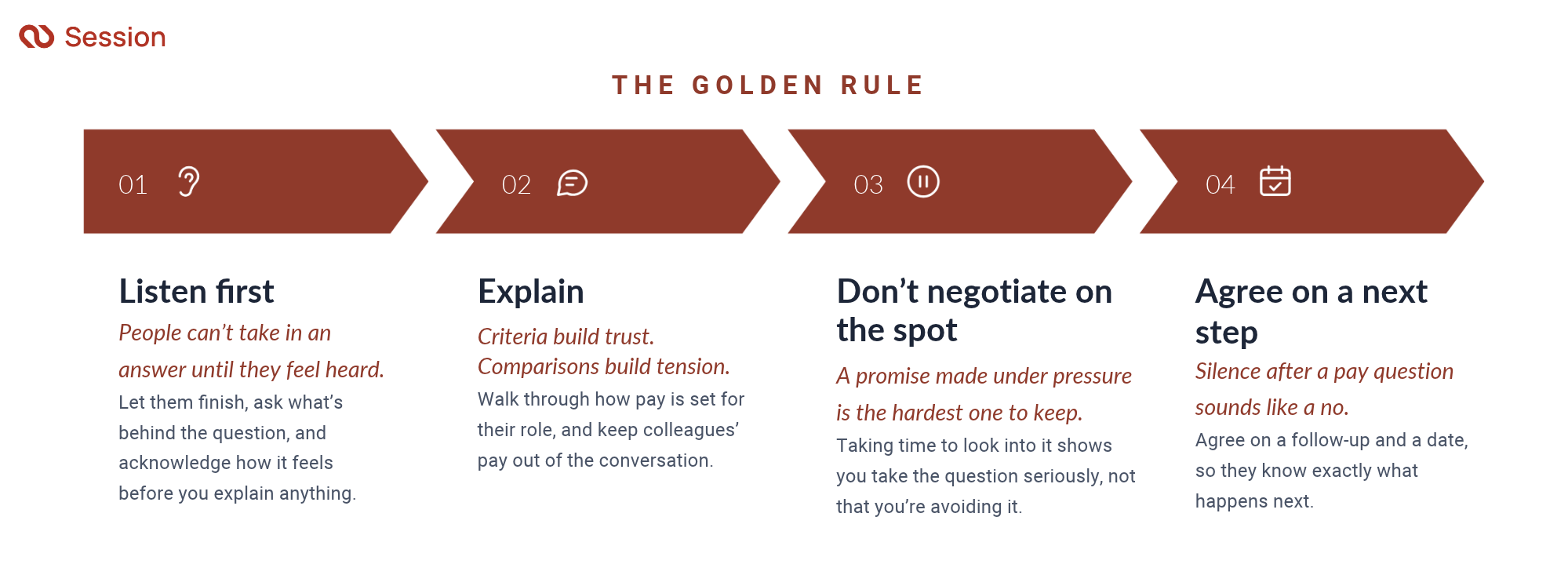
Your role in the moment is to explain, not to negotiate. Walk the employee through the criteria behind their pay as clearly and honestly as you can, but resist the urge to promise a raise or a review on the spot, however tempting it may feel. Instead, agree on a next step, whether that’s a follow-up conversation, a closer look together, or a clear date to come back with an answer. That way, the employee leaves the meeting feeling heard, and you have the room to give a fair response.
Three situations you may meet
“My colleague earns more than me”. This is often the most emotional version of the question, because it’s personal and it’s about someone they work with every day. Acknowledge how they feel before explaining anything, and then talk about the criteria that shape pay in their role: “I understand why that feels unfair. Let me walk you through how pay is set for roles like yours.” Avoid discussing the colleague’s salary or circumstances. That conversation belongs to them, and focusing on the criteria alone keeps things fair for everyone.
“The new hire earns more than me”. Here, the frustration is usually about loyalty and whether experience is being valued. Be honest that starting salaries can be shaped by the job market at the time of hiring, and show that you take the concern seriously: “That’s a fair question, and I want to look into it properly.” This can also be a good moment to talk about what the person brings to the team. Ask what they feel they do best and where they’d like to grow, so the conversation is about their value and future, not only the difference in pay. Avoid brushing it off with “that’s just the market.” Even if it’s true, it can sound like their commitment to the work ultimately counts for less.
“The numbers don’t make sense”. Sometimes an employee requests their pay information and finds a difference that you can’t easily explain. These are the moments that matter most for trust. Thank them for raising it, be open about what you don’t yet know, and commit to a clear next step: “You’re right to ask about this. I’ll take it to HR, and we’ll come back to you by a set date.” Avoid getting defensive or improvising an explanation. An honest “let me find out” will always build more trust than an answer you can’t stand behind.
For more guidance on preparing for and leading these conversations, take a look at our guide to difficult conversations, and if you’d like support preparing for conversations like these, coaching can help you find your own words and approach.
A final thought
Let’s return to that Tuesday in March. A team member closes the door and asks why a colleague earns more than they do.
With the right preparation, that moment no longer needs to feel like something to dread. You’ll know the criteria behind their pay, you’ll have a clear process to lean on, and you’ll be able to meet the question with honesty and care. What could have been an uncomfortable exchange becomes a conversation you can handle well.
In the end, pay transparency isn’t really about the numbers. It builds trust when you can explain your pay, and it costs trust when you can’t. The weeks ahead are your chance to make sure you can.