
When it comes to women and AI, there are two sides to the story, and they don’t quite line up.
On one hand, there is a real reason to be optimistic. Women are catching up when it comes to AI skills, and they’re doing it quickly. LinkedIn’s Economic Graph data shows that while men still have a higher overall concentration of AI skills, the year-on-year growth in AI talent has been faster among women. So this isn’t simply a story about women being “behind” on AI. Women are learning, adapting and closing the gap.
But there’s another side that’s harder to overlook. Women are still more likely to work in roles that are highly exposed to generative AI, particularly administrative and service-based roles. According to the International Labour Organization, around 29% of jobs held predominantly by women are exposed to generative AI, compared with 16% of those held predominantly by men. And in high-income countries, jobs at the highest risk of AI-driven automation account for 9.6% of female employment, compared with a much smaller share of male employment.
So if women are catching up when it comes to AI skills, while also being more likely to work in roles that AI could significantly change, what happens next?
Could AI help close the gender gap at work, or could it create a new one, where the bigger divide is not who has the skills, but who has the security and opportunity to adapt?
That’s what this guide sets out to explore.
The Current Picture
As mentioned, women are already making real progress when it comes to AI. They are picking up AI skills at a faster rate than men and gradually closing the gap in AI talent concentration, challenging the idea that women are simply “behind” when it comes to new technology.
But as said, skills are only part of the story. Women are still heavily represented in many of the roles most exposed to generative AI, including administrative and clerical work, customer service, education and healthcare support. That does not necessarily mean these jobs will disappear. In many cases, AI is more likely to change the tasks within them; taking over routine work, reducing admin and changing where people spend their time.
That is where the gender question becomes more complicated. If women are more likely to be in roles that are changing because of AI, telling them to simply “learn AI” misses a bigger part of the picture. They also need the time, support and opportunities to build new skills, move into different types of work and have a say in how their roles evolve.
For HR, the focus should be on making sure people can actually benefit from the changes AI brings. That means looking at who gets access to training, who has opportunities to progress, and whether AI is being used to create more space for work that depends on human judgement, creativity and connection.
Actionable steps for HR
There’s no single policy that will close the gender gap in AI. The starting point is understanding where work is changing, who has access to the skills to adapt and whether new ways of working are actually benefiting people.
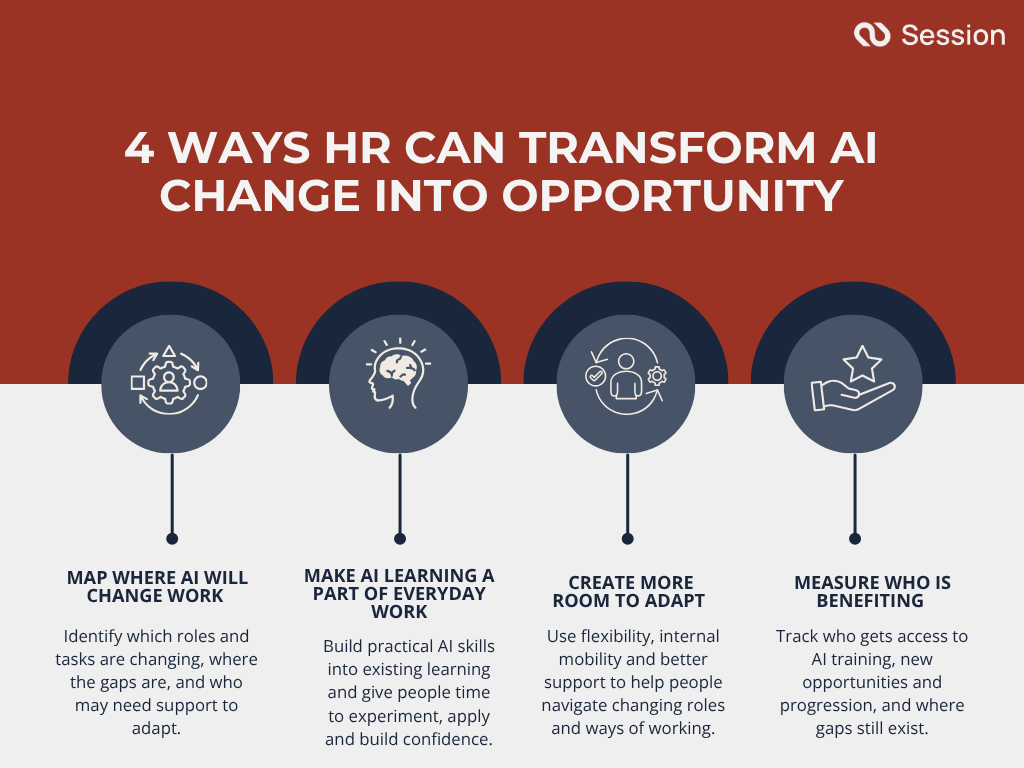
1. Map where AI will change work
- Identify the roles and tasks most likely to change as AI develops.
- Look at who is represented in those roles and where there may be gaps in AI skills or opportunities to move into new work.
- Use this to shape internal mobility plans early.
2. Build AI skills into everyday learning
- Make AI upskilling part of existing company infrastructure rather than a one-time training session.
- Focus on practical skills people can use in their actual roles, with time to experiment.
- Track who is participating and make sure training is reaching more than just the people who are already confident with technology.
3. Pilot more flexible ways of working
- Test flexible hours, shorter working weeks or other models that give people more control over when and how they work.
- Review parental leave and whether it supports both parents to participate.
- Treat new policies as pilots, measuring their impact on productivity, wellbeing and retention.
4. Measure who is benefiting
- Track AI training, internal mobility, progression and retention by gender, role and seniority.
- Look at whether flexible-work policies are being used and whether they are improving outcomes.
- If the same groups consistently gain access to new skills and opportunities, use that data to rethink your approach.
Conclusion
AI is changing the way we work, but it does not have to come at the expense of people. Used thoughtfully, AI and flexible work can give people more time, more choice and more space for the parts of work that truly matter. The challenge is making sure those benefits are available beyond the people who already have the most time, confidence or access to technology.
For HR, that means starting at the core root; with people rather than technology. Understand where work is changing, listen to what people need and create the space to learn and adapt. That does not require redesigning the entire workplace overnight. Start small, learn from what works and build from there.
We may not know exactly what work will look like in the years ahead, but we can influence what kind of workplaces we build. The real opportunity is to use AI to create more flexibility, more opportunity and a better experience of work for more people.