
I see it again and again – in Denmark and internationally
A highly capable leader, employee, or specialist sits across from me and tells me about a manager who fails to set clear priorities, changes direction along the way, or does not provide the support and attention they need.
My first question is almost always the same:
“Have you told your manager?”
There is often a silence.
Not because the person cannot see the problem. But because many of us – including experienced leaders – still tend to think of leadership primarily as something that flows downwards in an organisation. Leadership is something you exercise towards the people who report to you.
I see it differently.
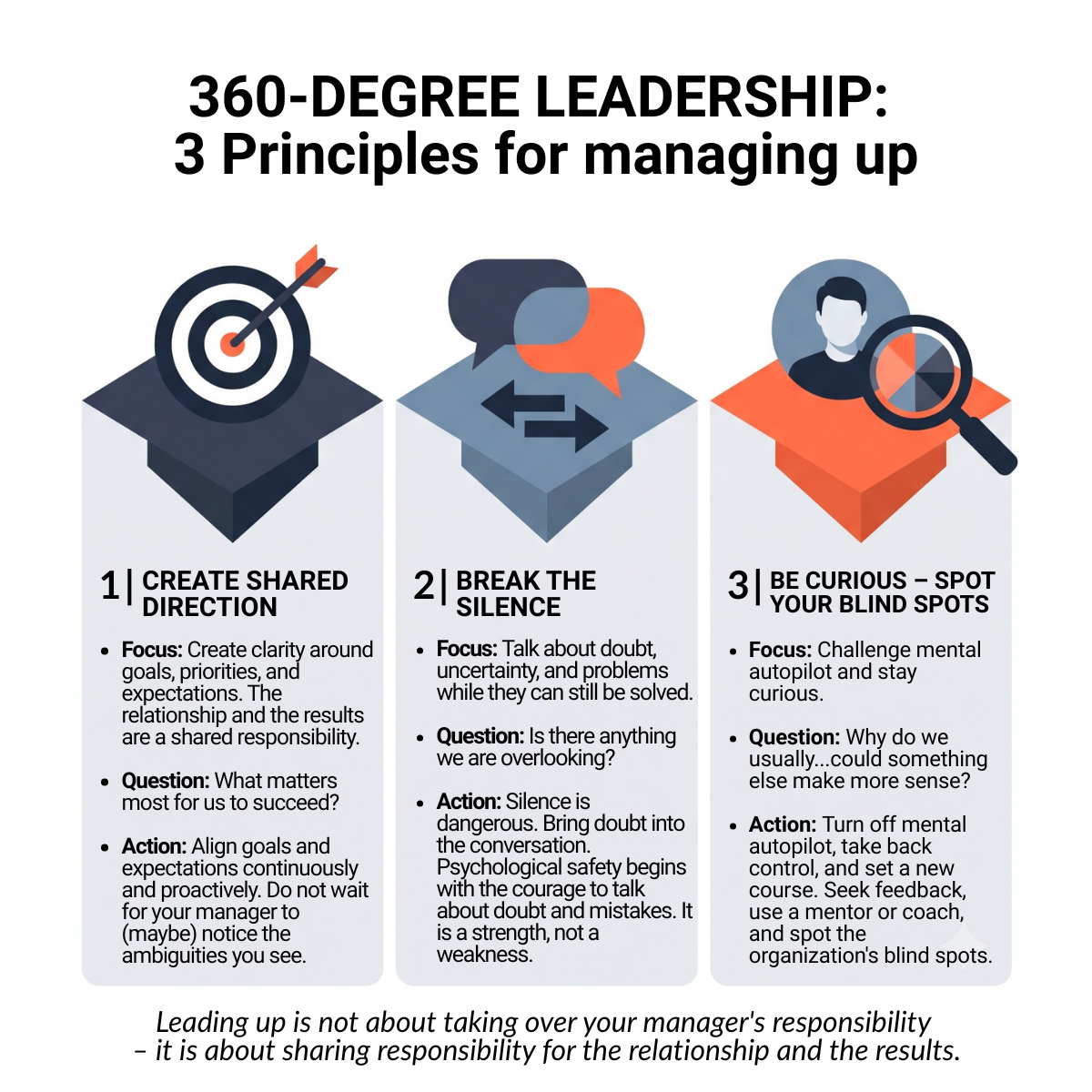
Good leadership works in 360 degrees. You lead downwards, sideways, inwards and outwards. But you also have a responsibility to lead upwards – or, perhaps more precisely, to take shared responsibility for the relationship with your own manager.
This is not about taking over your manager’s role. It is about creating the best possible conditions for succeeding together.
You cannot simply wait
Many people hope their manager will notice when priorities are unclear, when the framework is missing, or when things are moving in the wrong direction.
Sometimes they do.
But often they do not.
Peter Drucker’s philosophy of management was based on the idea that managers and knowledge workers share responsibility for creating results. This means that doing your own job well is not enough. You also need to help create clarity around goals, expectations, and priorities.
If you lack a clear mandate, if you are uncertain about the direction, or if the nature of the task has changed, it is rarely enough to wait for your manager to notice.
You need to bring it up.
Not because everything is your responsibility, but because the relationship is a shared responsibility.
Silence is an organisation’s hidden cost
Professor Amy Edmondson’s research into psychological safety shows that the best organisations are not necessarily those where the fewest mistakes are made.
They are the organisations where mistakes, doubts, and concerns are brought into the open while there is still time to do something about them.
That is why I often tell the leaders I coach:
“Silence is often dangerous.”
When employees or leaders keep their doubts to themselves, the organisation loses access to important knowledge. In a knowledge-based economy, that is a serious problem.
Misunderstandings grow.
Decisions become poorer.
And people spend unnecessary amounts of energy trying to guess what is actually expected of them.
It is rarely a question of lacking commitment.
More often, it is a question of lacking courage.
Vulnerability is not the same as weakness
Managing up is not about telling your manager how to lead.
It is about having the courage to raise the issues that would otherwise remain unspoken.
For example:
“I’m not sure I’ve understood the priorities correctly.”
“I feel that we are changing direction so often that it is becoming difficult to make progress.”
“I need greater clarity in order to succeed with this task.”
That takes courage.
But this is also how psychological safety is created.
Not through impressive value statements on the wall.
But because someone is willing to initiate the first difficult conversation.
Curiosity creates better leadership
Organisational psychologist Edgar Schein described “Humble Inquiry” as the ability to build relationships through genuine curiosity.
The same applies to the relationship with your own manager.
Instead of jumping to conclusions, you can ask:
“What is most important here?”
“How would you like to be involved?”
“Is there anything we might be overlooking?”
These kinds of questions create far better collaboration than assumptions do.
They also reduce the risk of working from different perceptions of reality.
Beware of organisational blindness
When we have spent a long time in the same organisation, we often begin to take its culture for granted. Culture can become a kind of mental autopilot: This is how we do things here. But why? And does it still make sense?
We get used to unclear decision-making processes.
To meetings where nobody says what they really think.
To conflicts that are never addressed.
We simply become blind to our own organisational environment and start operating on autopilot.
A good internal mentor can help you understand the organisation’s rules of the game.
An external coach can offer something different.
An external sparring partner stands outside the culture, looking in from the edge, and can ask the questions that people inside the organisation no longer think to ask. The autopilot can be switched off, control can be taken back, and a new course can be set.
That is precisely why an external coach can often expand your room to manoeuvre and help you see possibilities you can no longer see yourself.
Good leadership works in every direction
We talk a great deal about how leaders should develop their employees.
Perhaps we should talk a little more about how employees, specialists, and leaders can help develop their own managers.
Not through criticism.
But through dialogue.
Not by taking control.
But by taking shared responsibility.
Because the best relationship between a manager and an employee is not one in which one person does the thinking for the other.
It is one in which both take responsibility for the collaboration.
That is what I mean by 360-degree leadership.
And perhaps it is the most overlooked leadership discipline of them all.
Conclusion
Look up. Lead upwards. Take responsibility. Break the silence. Show vulnerability.
It sounds simple when put like that – but we all know that nothing is quite that simple.
When you are facing a significant challenge, do not face it alone. Identify the people who can help you. A good coach can, for example, help you find the courage to manage upwards.
Finding a good coach, starts with the first step: having a conversation. From there, you can determine whether one conversation is enough or whether more is needed. Often, it takes more – but that does not mean committing to a coaching process lasting years. Perhaps three or four conversations are enough.
And over the course of a long working life, that is almost nothing – but it can be a remarkable investment in your career and your life.